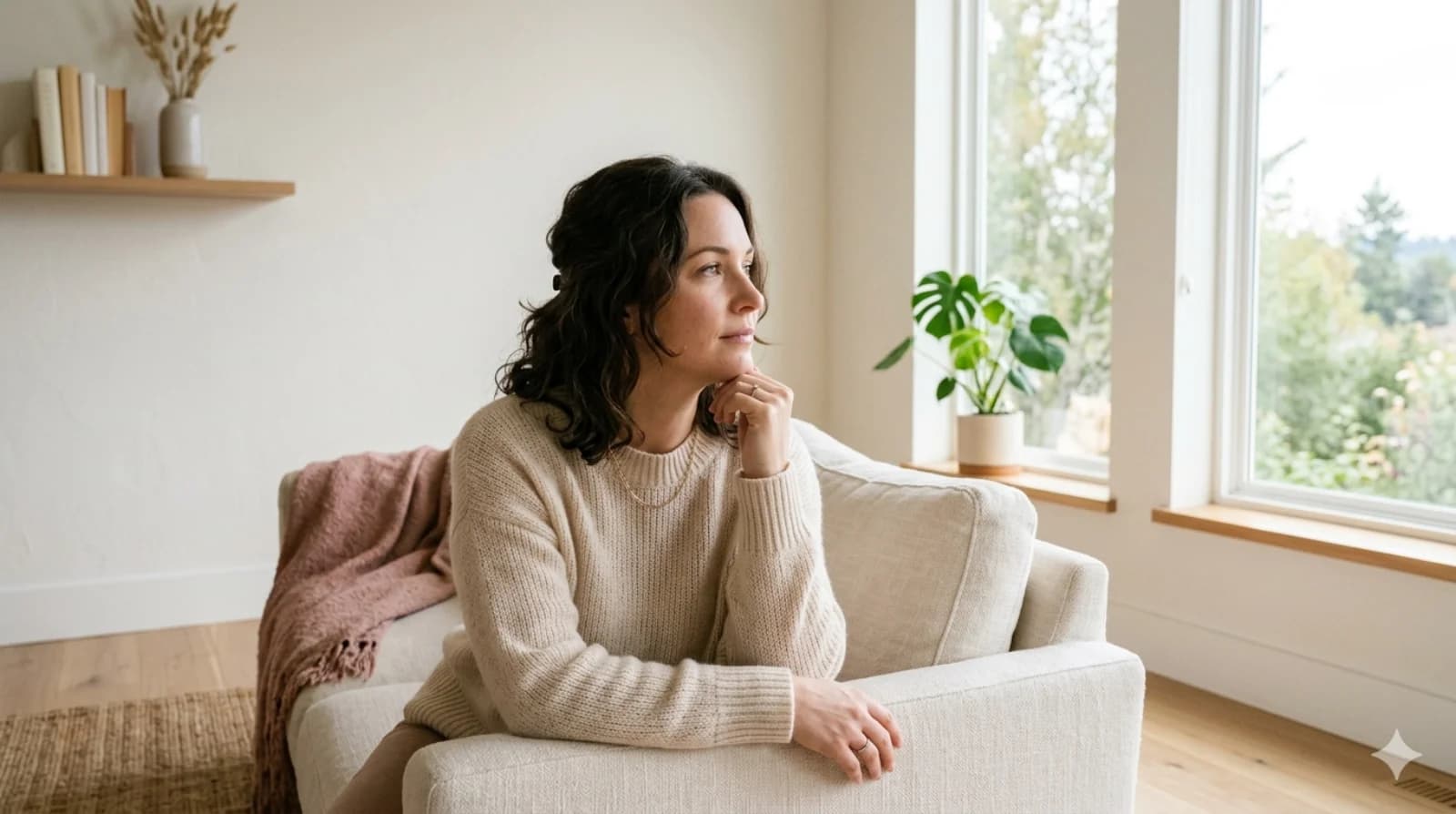
You used to be someone before "mom" became your whole name. You had opinions that were just yours, things that lit you up, a sense of who you were when no one needed anything from you. Now you catch your reflection and feel a quiet jolt: where did she go? If you have thought "I have lost myself in motherhood," you are not being ungrateful, and you are not alone. You are describing one of the most real and least talked-about parts of becoming a mother.
The feeling of disappearing
It is not that you do not love your children. It is that somewhere between the feeds and the logistics and the endless needs of everyone else, your own self got smaller and smaller until you can barely find her. You answer to "mom" all day. You are not sure you would know how to answer the question "what do you want?" anymore.
That ache has a name, and naming it helps.
This has a name: matrescence
The transition into motherhood is its own developmental stage, as profound as adolescence. There is even a word for it: matrescence. Just as a teenager's body, brain, identity, and relationships all shift at once, so do a new mother's. You are not the same person you were, and you are not yet sure who you are becoming. That in-between is disorienting, and it is completely normal.
We talk endlessly about the baby's development and almost never about the mother's. So when your sense of self wobbles, it feels like something is wrong with you. It is not. It is a transformation nobody prepared you for.
Why it happens
Part of it is practical: when every hour is spoken for, the parts of you that needed time and space, your friendships, your work, your interests, your quiet, get crowded out first. Part of it is biological: pregnancy and the postpartum period actually reshape the brain. And part of it is cultural: motherhood is still treated as a role that should swallow you whole, and asking for yourself back can feel selfish, even though it is the opposite.
So you did not fail at keeping yourself. You were carried under by a load that left no room for her.
You did not lose her. She is buried under the load.
This is the hopeful part. The woman you were is not gone. She is underneath the exhaustion and the mental load and the constant giving, waiting for a sliver of room. You do not have to choose between being a good mother and being yourself. The two are not enemies. A mother who has a self of her own is not taking something from her children. She is showing them what a whole person looks like.
How to find your way back
You do not reclaim yourself in one grand gesture. You do it in small, deliberate moments that say: I am still here.
- Start with one small thing that is yours. Not productive, not for anyone else. Ten minutes of a book, a walk without the stroller, music you actually like. The point is choosing something because you want it.
- Lower the load so there is room. You cannot find yourself in the cracks of a 100 percent full plate. Hand off whole responsibilities, outsource what you can, let some things be good enough. Space is the prerequisite, not the reward.
- Reconnect with who knew you before. A friend, a sibling, anyone who remembers you as more than someone's mother. Being seen as yourself, even for an hour, is powerful.
- Be patient with the in-between. You are not going back to exactly who you were. You are becoming someone new who carries her forward. That takes time, and it is allowed to be messy.
You are still in there
Losing yourself in motherhood is not a sign that you love your children too little or are doing it wrong. It is a sign that you have been pouring out without being refilled, and that you, like your children, deserve room to exist.
If part of finding yourself again is getting some of the weight off your plate, that is exactly what AlphaMa was built for: a voice-first AI life partner that helps carry the mental load so there is finally space for you. You can also map what you are carrying with our free Mental Load Audit, or read more about the mental load in motherhood.