Almost ten years after Ida Tin coined the term "femtech," the industry is on the edge of something genuinely different. For years, women's health tech meant tracking apps. Log your period. Record your symptoms. Maybe get a fertility window prediction. Useful, but shallow.
This article is part of the AlphaMa guide to postpartum support.
2026 is the year that changes. And mothers stand to benefit more than anyone.
From tracking to measurable biomarkers
The biggest shift happening in femtech right now is the move from self reported symptom logging to actual biomarker collection. Justyna Strzeszynska, founder and CEO of Joii, puts it plainly: women have been expected to self report symptoms without being given meaningful clinical metrics. That is starting to change.
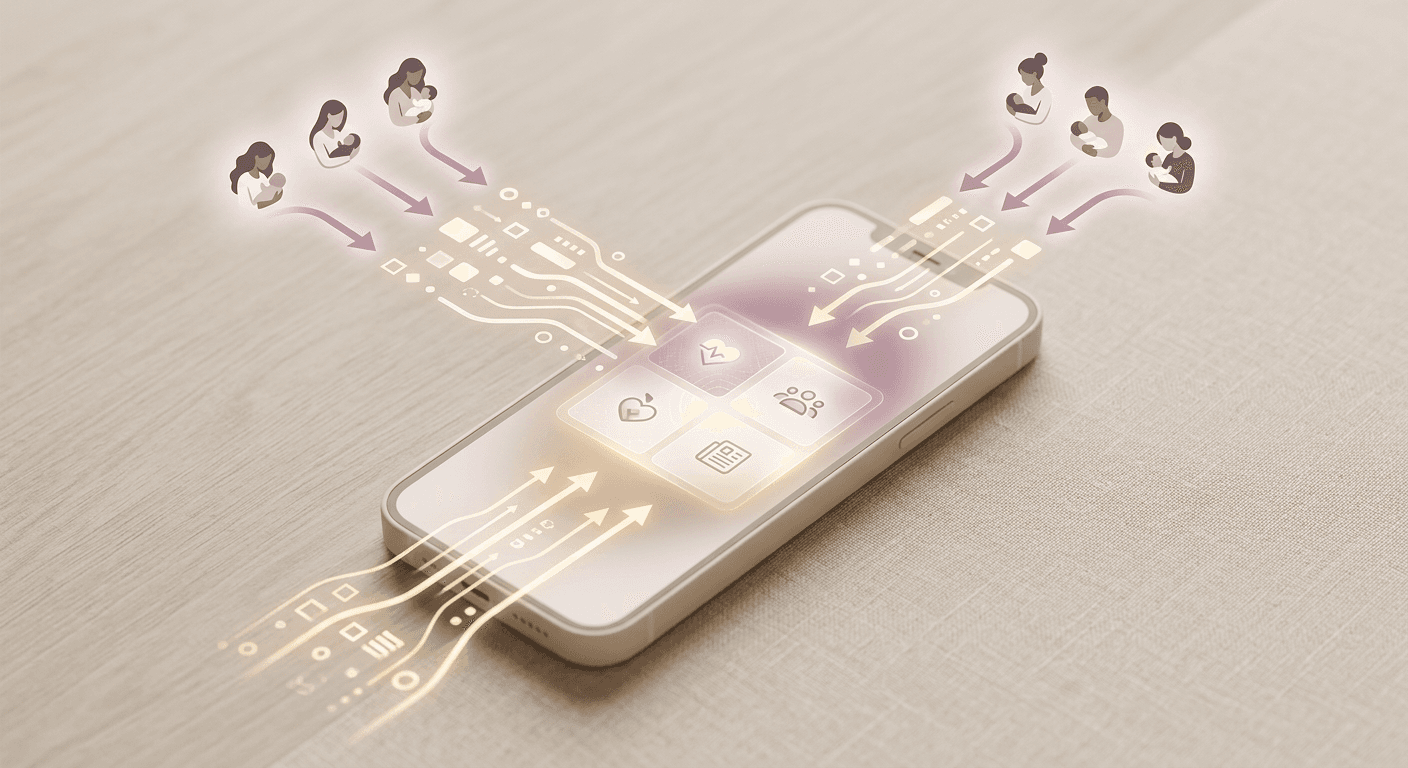
The next wave of femtech will be driven by biomarkers, not just tracking. This matters enormously for postpartum mothers, whose hormonal shifts, sleep disruption, and emotional changes are currently assessed almost entirely through questionnaires and self reporting. Imagine instead that wearable data, hormonal markers, and behavioral patterns combine to flag postpartum depression risk before a mother even realizes something is wrong.
AI becomes a practical partner, not a gimmick
The conversation around AI in healthcare often swings between utopian promises and dismissive skepticism. But what is emerging in femtech is neither. It is practical, grounded, and increasingly effective.
Strzeszynska describes the next wave of AI as contextual intelligence. Not a black box that diagnoses everything, but a system that identifies patterns, tracks changes over time, and turns everyday markers from cycle data, wearables, and mental health check-ins into actionable insights for both clinicians and users.
For mothers carrying an invisible mental load that never stops, this kind of AI is a game changer. Not because it replaces human judgment, but because it sees patterns that a sleep deprived, overwhelmed parent cannot. It notices that sleep quality has been declining for three weeks. It catches that anxiety check-in scores have shifted. It connects the dots between hormonal data and mood patterns in ways that were previously invisible.
Hyper personalised care finally becomes real
For decades, women's health tools were built on incomplete data sets and assumptions that failed to reflect real hormonal, emotional, or life stage complexity. Anastasia Shubareva-Epshtein, founder and CEO of Carea, says 2026 will be a defining year as the industry shifts from generic solutions toward deeply personalised and truly women centred care.
Advances in AI will accelerate this shift. Digital health platforms are becoming capable of delivering support that adapts to a woman's individual biology, emotional state, and daily experience.
This is not a minor improvement. This is the difference between an app that tells you "drink water and get rest" and one that understands you are three months postpartum, your cortisol patterns suggest chronic stress, your sleep data shows you are getting fragmented rest, and your mood tracking indicates early signs of anxiety. Then it adjusts its recommendations accordingly.
Menstrual blood as a diagnostic tool
One of the more surprising trends emerging in 2026 is the use of menstrual blood as a diagnostic tool. Period products are evolving from passive absorbents to data enabled health touchpoints that can measure markers for conditions like fibroids, anaemia, adenomyosis, and suspected endometriosis.
While this specific innovation targets menstrual health rather than the postpartum period directly, it represents a broader principle: women's bodies produce data that medicine has historically ignored. As the infrastructure for collecting and analyzing that data matures, it creates pathways for better postpartum monitoring and maternal health tracking as well.
The funding gap remains
Despite these advances, the funding picture for women's health innovation remains bleak. Women founders still receive just 2% of global venture funding, according to FemTech World's 2026 analysis. Proven innovations in women's health still struggle to find investors.
This is not just an equity problem. It is a market failure. The femtech market is projected to reach billions, untreated maternal mental health conditions cost the US an estimated 14 billion dollars per birth cohort in lost productivity and healthcare costs, and yet the companies building solutions for half the population cannot get funded at scale.
Charlotte Lewis, principal associate at Mills & Reeve, notes that while fertility solutions are thriving, innovation in menopause, sexual health, and non hormonal contraception continues to lag due to funding gaps. Sustained investment and cross sector collaboration are vital to ensure innovation benefits all aspects of women's health, she says.
What this means for mothers right now
The practical takeaway is not that you should wait for some perfect AI health companion to appear. It is that the infrastructure for genuinely personalised maternal care is being built right now. Wearables like the Oura Ring are already capturing cycle and hormonal signals. Continuous glucose monitors are providing metabolic insights. AI platforms are learning to interpret this data in context.
The mothers who engage with these tools early, who track their data, who participate in research and provide feedback to these companies, are the ones who will shape what maternal health technology becomes.
This is a moment where technology is finally catching up to what mothers have always known: that their health is complex, interconnected, and deserves far more than a one size fits all approach. At AlphaMa, we are building AI that understands the full picture of a mother's mental and emotional experience, meeting her where she is with support that adapts to her reality, not the other way around.
Sources
- FemTech World, January 2026: Women's health enters a new era, the trends shaping femtech in 2026 https://www.femtechworld.co.uk/insight/womens-health-enters-a-new-era-the-trends-shaping-femtech-in-2026-ftai26/
- CNBC, March 2023: Clue co founder Ida Tin coined the term femtech in 2016 https://www.cnbc.com/2023/03/06/meet-the-woman-who-invented-a-whole-new-subsection-of-tech-set-to-be-worth-1-trillion.html
- Mathematica, 2019: untreated perinatal mood and anxiety disorders cost the United States an estimated 14.2 billion dollars for the 2017 birth cohort https://www.mathematica.org/publications/societal-costs-of-untreated-perinatal-mood-and-anxiety-disorders-in-the-united-states
- TechCrunch, January 2023, on PitchBook data: startups with all women founders raised 1.9 percent of US venture funding in 2022 https://techcrunch.com/2023/01/18/women-founded-startups-raised-1-9-of-all-vc-funds-in-2022-a-drop-from-2021/