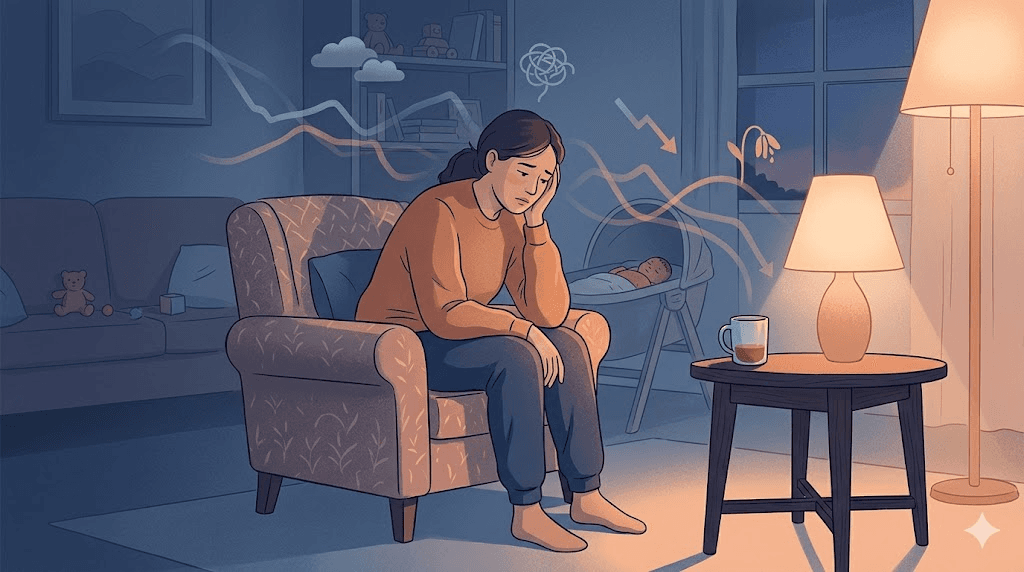
A study published in JAMA Internal Medicine in 2025 tracked nearly 200,000 American mothers between 2016 and 2023. The findings were stark. Mothers reporting "excellent" mental health fell from 38.4% to 25.8%, a drop of roughly one third. Those reporting "fair" or "poor" mental health nearly doubled, rising from 5.5% to roughly 9%.
This article is part of the AlphaMa guide to postpartum support.
These numbers come from self reported survey data, which means they likely understate the problem. Mothers who are barely holding it together are not always filling out health surveys.
What makes this study different
Maternal mental health research has historically focused on clinical diagnoses: postpartum depression, anxiety disorders, PTSD from birth trauma. Those are critical, and they affect roughly 1 in 5 mothers. But this study looked at the broader population. Not just mothers in crisis. All mothers. And it found that the entire distribution shifted downward.
Even mothers who would never meet criteria for a clinical diagnosis are struggling more than they were seven years ago. The middle is collapsing. The number of women rating their mental health as "very good" also dropped, while "good" and "fair" categories swelled.
This is not a story about illness. It is a story about erosion.
Why now? Seven factors driving the decline
The mental load became measurable. Researchers at the University of Bath published a 2025 study of 2,133 partnered heterosexual parents in the US. They found that regardless of career success, income, or education level, mothers carry the majority of household cognitive labor. The remembering, the planning, the anticipating. It does not redistribute when women earn more. It just stacks.
The support infrastructure collapsed. The pandemic accelerated what was already happening. Grandparents who helped with childcare became harder to access. Community bonds frayed. The "village" that previous generations relied on had been shrinking for decades, and COVID made it visible.
Workplace flexibility created a trap. Remote work sounded like a win for mothers. In practice, it merged two full time jobs into the same space and time. Mothers working from home reported higher rates of interruption, multitasking, and role conflict than mothers working on site. Flexibility without boundaries is not freedom.
Social media comparison intensified. The Instagram version of motherhood, curated, aesthetic, emotionally composed, became the default reference point. Research from the University of Oxford found that mothers who spent more than 90 minutes daily on social media reported significantly lower wellbeing than those who used it less. The comparison gap is not imaginary. It is designed.
The policy gap widened. The US remains the only OECD country without guaranteed paid maternity leave. Childcare costs have risen faster than inflation every year since 2016. The Policy Center for Maternal Mental Health reported in 2026 that states with the weakest family policies had the steepest mental health declines among mothers.
Physical health declined too. The same JAMA study found that mothers reporting excellent physical health also dropped significantly. Mental and physical health are not separate systems. When one erodes, the other follows.
The mental health system was not built for mothers. Most therapy models are individualistic. They treat the mother as a patient with a condition. But maternal mental health is relational, contextual, and deeply tied to structural factors that therapy cannot fix. You cannot meditate your way out of a childcare crisis.
Who is affected most
The JAMA study found that the decline was not evenly distributed. Low income mothers, mothers without a college degree, and mothers in rural areas experienced the steepest drops. Black and Native American mothers reported some of the worst mental health outcomes, reflecting compounding effects of structural racism, healthcare access gaps, and economic precarity.
But no group was immune. Even college educated, higher income mothers in urban areas showed significant declines. This is a population level shift, not a vulnerability story.
What the numbers miss
Surveys capture a snapshot. They do not capture the texture of daily life for a mother who is functioning but depleted. The mother who gets everyone out the door on time but cannot remember the last time she had a thought that was entirely her own. The mother who is performing wellness while quietly drowning in logistics.
The European Make Mothers Matter campaign found in 2025 that more than two thirds of mothers across Europe feel mentally overloaded. This is not an American problem or a policy problem alone. It is a structural feature of how modern societies organize care.
What would actually help
The research points to several interventions that work:
Redistribute the mental load at the household level. The Bath study found that in families where partners actively shared cognitive labor, not just tasks but the planning and remembering, mothers reported significantly better mental health. Shared calendars and divided chore lists only work when both partners carry the anticipatory thinking, not just the execution.
Build digital support that reduces cognitive burden. Tools that externalize the mental load, that remember, remind, anticipate, and organize, can function as a cognitive prosthesis for mothers. Not another app to manage. A system that manages itself.
Invest in community infrastructure. Mothers with access to even one regular, reliable support person (a family member, a neighbor, a paid helper) reported measurably better mental health than those without.
Treat maternal mental health as a public health issue, not an individual one. Screenings are important. But they only identify problems. The solutions need to address the structural conditions creating the distress in the first place.
Where AlphaMa fits
AlphaMa was built on the premise that the mental load is not a personal failure to manage. It is a systems problem that requires a systems solution. By using AI to handle the planning, remembering, and anticipating that consume so much maternal bandwidth, AlphaMa gives mothers back something the data shows they are losing: mental space.
Not a meditation app. Not a therapy platform. A tool that reduces the burden before it becomes a crisis.
The JAMA numbers are a warning. But they are also a map. They show exactly where the pressure is building. And they point toward the kind of intervention that could actually relieve it.
Sources: JAMA Internal Medicine (2025), University of Bath (2025), Policy Center for Maternal Mental Health (2026), Make Mothers Matter campaign (2025), University of Oxford social media and wellbeing research
Sources
- Study published in JAMA Internal Medicine in 2025: https://jamanetwork.com/journals/jamainternalmedicine/fullarticle/2834318