You forgot why you walked into the room. You put the milk in the pantry. You started a sentence and lost it halfway through. You laughed it off as mom brain.
Everyone does. It's practically a punchline at this point. Ha ha, mom brain. So scattered. So forgetful.
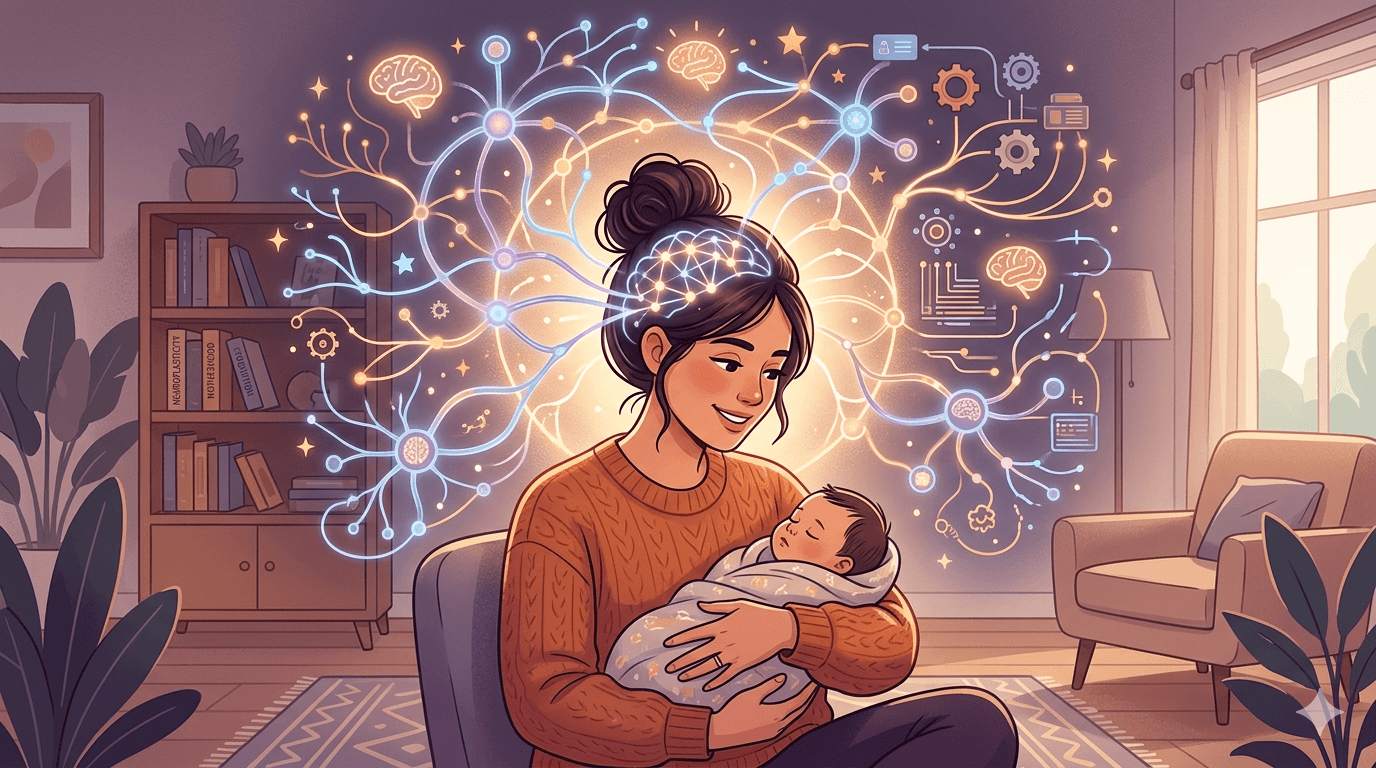
But here's what nobody tells you: mom brain is not a character flaw. It's not a sign that you're falling apart. It's your brain undergoing one of the most significant structural changes of your adult life, and it's completely normal.
What's Actually Happening in Your Brain
Research published in Nature Neuroscience found that pregnancy literally reshapes a woman's brain. Gray matter volume decreases in areas involved in social cognition. That sounds alarming until you understand what it means. Your brain is becoming more specialized, more efficient at reading your baby's needs, more attuned to threats, more responsive to crying.
The hippocampus, your memory center, actually shrinks during pregnancy. That's not damage. That's remodeling. Like gutting a kitchen to build a better one. During construction, things don't work as smoothly. You forget where you put your keys.
The amygdala, your threat detection center, becomes hyperactive. This is why you hear your baby cough from three rooms away while your partner sleeps through it. Your brain is running a background surveillance system that never turns off.
This is not a glitch. This is an upgrade. But it comes with tradeoffs.
Why You Feel Like You're Losing It
The brain fog is real. The forgetfulness is real. The inability to focus on anything for more than 90 seconds is real.
But it's not because something is wrong with you. It's because your working memory, the mental scratchpad you use to hold information temporarily, is overwhelmed. You're not just remembering your own life anymore. You're tracking feeding schedules, sleep windows, wet diapers, doctor appointments, milestone checklists, and whether you already ate today. All while sleeping in fragments.
The cognitive load of new motherhood has been compared to returning to work after a long absence while simultaneously learning a new language. No one would call that brain fog a personal failure. They'd call it expected.
The Part Nobody Talks About
Mom brain doesn't go back to "normal." It doesn't snap back. Your brain is permanently different after having a baby.
This terrifies some women. It shouldn't.
The same studies that found gray matter reduction also found that these changes persisted for at least two years postpartum and were associated with stronger maternal attachment. The brain that forgets where it parked the car is the same brain that can distinguish its own baby's cry from a room full of crying infants.
The tradeoff is real. You gained extraordinary sensitivity and connection. You lost some of the sharp edges of your pre-baby cognitive style. Most women eventually find a new baseline that integrates both. But it takes time. Months. Sometimes years. And almost no one tells you that.
How to Work With Your New Brain
Stop fighting it. Trying to force your postpartum brain to work like your pre-baby brain is like trying to run new software on old hardware. It just won't fit. Accept that your memory works differently now and build systems around it.
Externalize everything. Your working memory is overloaded. Move things out of your head and into a system. Notes, voice memos, reminders, shared calendars. If it's only in your brain, it's at risk.
Use your voice. The fastest way to capture something when your hands are full and your brain is scattered is to say it out loud. Voice-first tools aren't a convenience for moms. They're a necessity.
Stop apologizing. Every time you say "sorry, mom brain," you're reinforcing the idea that there's something wrong with you. There isn't. Your brain did exactly what it was supposed to do.
Give it time. The research suggests the remodeling continues for years. You're not broken. You're under construction.
The Bigger Picture
The term "mom brain" is used to dismiss women. To make mothers feel less than. To pathologize a normal, extraordinary biological process.
Your brain didn't get worse. It got different. It got more attuned, more responsive, more protective. It just didn't get a manual.
At AlphaMa, we understand that the mom brain isn't a bug. It's a feature. That's why we built a companion that works the way your brain works now. Voice first. Context aware. Always listening, so you don't have to remember everything yourself.
Download on iOS or get it on Google Play.
Related reading:
Sources
- Hoekzema and colleagues, Nature Neuroscience 2017: pregnancy produces gray matter changes in social cognition regions that predicted postpartum maternal attachment and endured at least two years https://www.nature.com/articles/nn.4458
- Gustafsson and colleagues, Nature Communications 2013: parents can identify their own baby's cry among other infants' cries https://www.nature.com/articles/ncomms2713
- Cowan, Behavioral and Brain Sciences 2001: working memory holds about four chunks at once https://www.cambridge.org/core/journals/behavioral-and-brain-sciences/article/magical-number-4-in-shortterm-memory-a-reconsideration-of-mental-storage-capacity/44023F1147D4A1D44BDC0AD226838496
- Aviv and colleagues, Archives of Women's Mental Health 2024: cognitive household labor falls mostly on mothers and correlates with poorer maternal mental health https://pmc.ncbi.nlm.nih.gov/articles/PMC11761833/