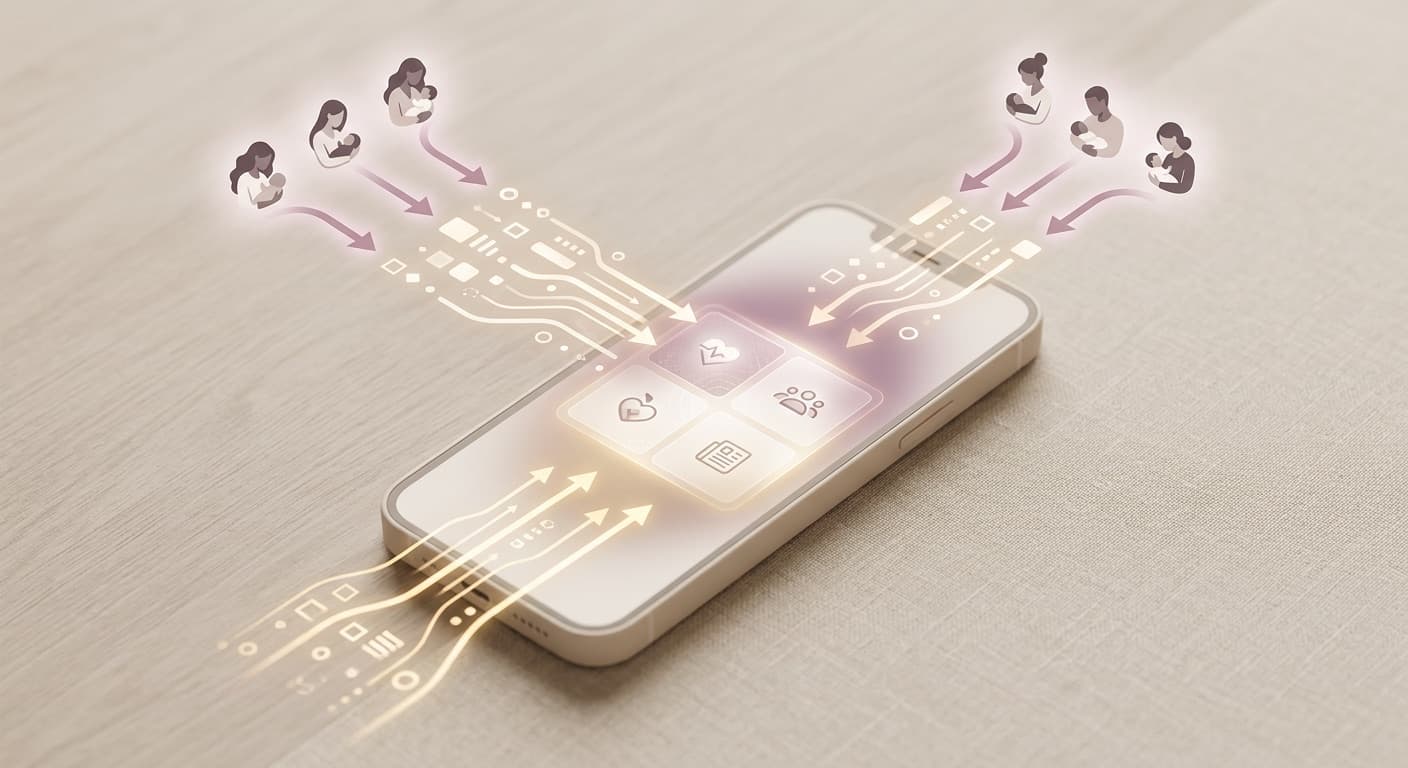
Part 8 of the AlphaMa Framework for Maternal Mental Load
The Manifesto. Next: Start again: The Definition →
There are tens of thousands of apps in the parenting category. Shared calendars. Chore charts. Meal planners. Medication trackers. Breastfeeding logs. Pregnancy journals. Sleep trainers. Co-parenting coordinators. Mental health apps. Meditation apps. Reminder apps.
Forty thousand apps. And mothers are still exhausted.
This is not a software problem. It is an architecture problem. And no number of apps will solve it, because apps are the wrong unit.
Here is why.
The app mentality
An app does one thing. A calendar app shows you dates. A meal planner suggests recipes. A chore chart tracks tasks. Each app is a standalone tool that solves a specific problem within a defined boundary.
This works when your problems are modular and independent. If you need to track your runs, a running app is perfect. If you need to manage a project at work, a project management tool is exactly right.
But motherhood is not modular. It is a system.
The pediatrician appointment affects the work calendar. The work calendar affects the childcare schedule. The childcare schedule affects the grocery list, because you need snacks for the days she is home. The grocery list affects the budget. The budget affects whether you can book the babysitter for the class you want. The babysitter affects the relational loop with your partner, because date night depends on her availability.
Every part of family life is connected to every other part. An app that manages one piece without awareness of the others is not solving your problem. It is adding a new interface to manage.
The average mother we have spoken with uses between six and twelve apps related to family management. That is six to twelve separate interfaces, six to twelve separate logins, six to twelve separate data streams that do not talk to each other. She becomes the integration layer. She is the one who sees that the school calendar conflicts with the work meeting, because the school app and the calendar app do not communicate. She is the one who remembers that the meal plan needs to account for the allergy form she submitted to daycare, because the meal planner and the health tracker are made by different companies.
She is not using apps. She is running the operating system that connects them. And she is doing it manually, in her head, with no documentation, no support, and no off switch.
What an operating system does
Think about what an operating system does on a computer.
It does not do tasks. It does not write documents or edit photos or send emails. What it does is manage the relationships between all the programs that do those things. It allocates memory. It schedules processes. It handles interrupts. It manages priorities when two things compete for the same resource. It provides a file system so that data created in one program can be found and used by another. It runs in the background, invisible, and without it, every application would have to be self contained and none of them could share data.
A mother is an operating system.
She allocates cognitive memory: which loops to hold active, which to park, which to archive. She schedules processes: what happens when, in what sequence, with what dependencies. She handles interrupts: the fever at 2am, the school call at 10am, the crying at pickup. She manages priorities when resources are scarce: if she can only do three things today, which three, and what falls. She provides the data layer: she is the one who knows that the allergy information from the pediatrician needs to reach the daycare teacher and the meal plan and the babysitter.
This is not a job description. It is an architecture. And the reason mothers are breaking is not that they have too many tasks. It is that they are running a complex, real time, multi user operating system inside a single human brain that was never designed for this workload.
Why no app can be the operating system
Each of the forty thousand parenting apps is well designed. Many are genuinely useful. But none of them can serve as the operating system, because none of them has access to the full data stream of family life.
The calendar app knows about dates but not about health. The health app knows about symptoms but not about logistics. The meal planner knows about food but not about schedules. The chore chart knows about tasks but not about the emotional weather of the household. The budgeting app knows about money but not about time.
The mother is the only entity in the system that holds all of these data streams simultaneously. She is the bus. She is the memory controller. She is the scheduler. And every new app she adds to her life increases her workload rather than reducing it, because she now has to maintain another data silo and manually sync it with everything else.
This is why mothers try a new app, feel hopeful for a week, and then abandon it. It is not that the app is bad. It is that the app cannot do the thing she actually needs, which is integration. The app adds a tool. She needs fewer tools and more connective tissue.
Motherhood as a systems problem
A systems problem is one where the behavior of the whole emerges from the interaction of its parts, not from any single part in isolation. You cannot solve a systems problem by optimizing one component. You have to redesign the relationships between components.
Family life is a systems problem. The parts are health, logistics, household, relationships, career, education, and emotional regulation. The behavior of the whole emerges from how those parts interact: how a health event cascades into schedule changes, how a schedule change affects the meal plan, how a meal plan failure creates stress that affects emotional regulation, how emotional dysregulation affects work performance, which affects the budget, which affects the options available next week.
No app solves this. No combination of apps solves this. The solution requires something that can see across all the parts, understand the dependencies, and act on them as an integrated whole.
It requires an operating system.
What a maternal operating system would do
If we take the operating system metaphor seriously, a cognitive operating system for motherhood would need five core capabilities:
Memory. A persistent, structured store of everything the family needs to know. Allergies, preferences, schedules, histories, contacts, open loops. Not a list. A living database that remembers so she does not have to.
Scheduling and prioritization. The ability to see all demands on the family's time and cognitive resources, resolve conflicts, sequence activities, and reallocate when something changes. Not a calendar. A scheduler that understands dependencies and can re plan when a fever cancels everything.
Interrupt handling. The ability to absorb unexpected events without destabilizing the entire system. When the school calls at 10am, the system reschedules the work meeting, arranges pickup, notifies the partner, and adjusts the rest of the day automatically.
Inter process communication. The ability to share information across domains seamlessly. The pediatrician's allergy note reaches the daycare, the meal plan, the babysitter, and the school without the mother manually copying data between them.
Prediction and anticipation. The ability to see what is coming before it becomes urgent. Vaccines due in two weeks. Clothes about to be outgrown. A birthday that needs planning. The system surfaces these proactively, not as reminders, but as prepared actions ready for approval.
No app does any of this. No combination of apps does this. This is an operating system, and it is what mothers have been building from scratch, by themselves, in their own heads, for every family, over and over, for generations.
Why AI changes what is possible
For the first time, we can build this.
AI agents can serve as the process layer of this operating system. They do not replace the mother's judgment. They handle the execution of the loops she is carrying. They book, research, coordinate, fill, call, schedule, and confirm. They do this with awareness of the full family context, not as isolated tools.
The memory layer can be persistent and structured. The family's information lives in one place, not scattered across twelve apps. The scheduler can see across all demands and propose resolutions. The interrupt handler can absorb a 2am fever without the mother rebuilding the entire next day from scratch.
This is what AlphaMa is building. Not another app. Not a better checklist. An operating system for the cognitive work of running a family. One that sees across all domains, that closes loops instead of tracking them, that carries the load instead of mapping it.
The problem was never that mothers need better tools. The problem is that they have been doing the work of an operating system with no operating system. AI is the first technology that can change that.
Not another app. The thing that runs underneath all the apps, so she can finally stop.
This article is part of the Maternal Mental Health Series (MMH) from AlphaMa. The Cognitive Operating System is an original AlphaMa framework. Learn more at alphamothers.com.
This framework is part of the Alpha Mothers research program. The full research model, The Alpha Mothers Framework: Four Layers of the Invisible Crisis, maps women's mental health across the lifecycle and is backed by 60+ peer-reviewed sources. It is free to read at alphamothers.com/research.
Sources
- University of Bath via ScienceDaily, December 2024: mothers manage about 71 percent of household cognitive labor, Journal of Marriage and Family https://www.sciencedaily.com/releases/2024/12/241212150327.htm
- Daminger, American Sociological Review 2019: cognitive labor means anticipating, identifying options, deciding and monitoring, and women do more of it, especially anticipation and monitoring https://journals.sagepub.com/doi/10.1177/0003122419859007
- Pew Research Center, June 2026: 81 percent of full time working moms handle parenting tasks while at work https://www.pewresearch.org/social-trends/2026/06/16/for-working-parents-the-boundary-between-work-and-family-is-often-blurred/