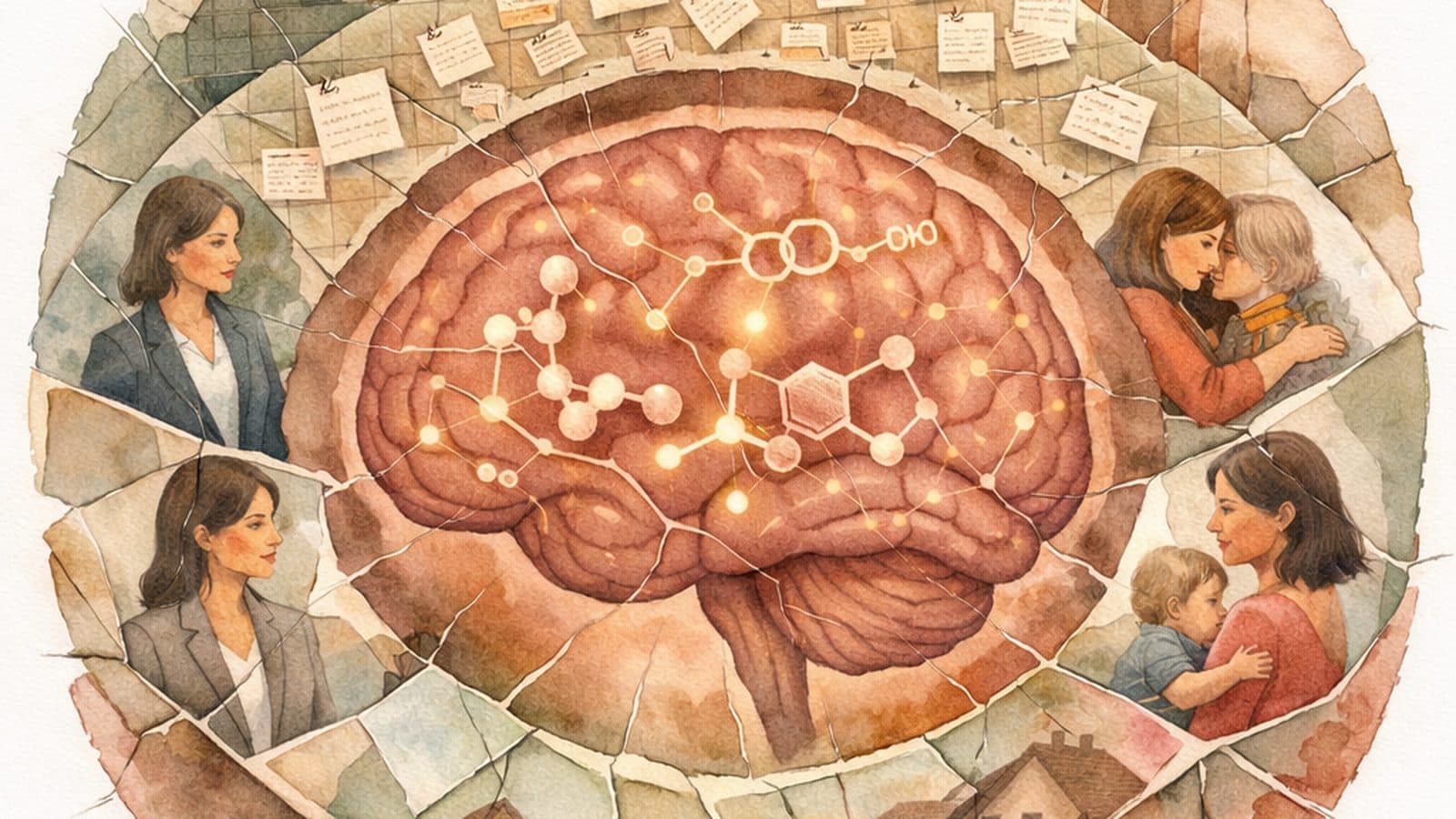
Mothers are one of the fastest growing groups of new ADHD diagnoses, and the timing is not a coincidence. The mental load has been doing the compensating for years, and motherhood is the moment the compensating system collapses.
The story arrives on repeat in clinics and in the stories mothers tell each other. She made it through school through raw intelligence and deadline adrenaline. She built systems, sticky notes, alarms, a lifetime of them. Then the baby came, sleep shattered, routines dissolved, and suddenly the woman who ran entire projects could not reliably send a form back to daycare. SELF reported in early 2026 on ADHD diagnoses rising in mothers of young children, the Motherhood in ADHD podcast sits in the top rankings, and Amazon sells an entire shelf of ADHD mom planners. None of that is a trend. It is a cohort finally being seen.
Why Motherhood Unmasks ADHD
ADHD in girls and women has always been underdiagnosed because it rarely looks like the stereotype. It looks like a bright, messy, anxious perfectionist who is late to everything and ashamed about it. The clinical framing is that women mask, and masking works, right up until the conditions that made it possible are removed.
Motherhood removes all of them at once. Sleep, the first thing ADHD brains run on, fragments. External structure, the second thing, disappears along with the office. And then the job changes: managing a household and a small human is essentially executive function with no off switch. Noticing, holding, sequencing, tracking, initiating. Every function ADHD taxes, in one unpaid position with no performance review except the one she gives herself at 2 AM.
Where ADHD and the Mental Load Collide
The mental load, the anticipating and remembering that mothers still carry about 71 percent of, is executive function wearing an apron. Which means the ADHD mom is not failing at a fair test. She is running the most executive function intensive job in the household on the brain architecture least resourced for it.
The collision shows up in patterns mothers instantly recognize. Working memory that drops the thought mid sentence becomes a daily humiliation instead of an occasional glitch. Time blindness turns the school run into a chronic crisis. Task initiation stalls not from laziness but from a brain that cannot find the on ramp. And the shame spiral is its own second condition, because she can see the gap between her standards and her output better than anyone.
Why the Standard Advice Backfires
Hand an ADHD mom a planner and you have handed her one more system to run, maintained by the exact functions the planner is meant to replace. The advice industry keeps prescribing more self management to a condition defined by self management being expensive. It does not scale, and then it fails quietly, which she interprets as personal failure number forty one.
Delegation advice backfires for the same reason. Delegating a task does not offload the loop, because someone still has to notice, track, and follow up, and that tracking is the actual burden. A mother whose working memory cannot reliably hold a pediatrician referral cannot delegate her way out of remembering the referral. The load has to move, not just the task.
What Actually Helps
First, evaluation. If any of this reads like your internal weather, a real assessment with a clinician who understands adult women is the single highest leverage step, and medication plus therapy meaningfully changes outcomes for many. Second, externalize everything: bodies, alarms, and lists exist so the brain does not have to hold the job open. Third, offload the tracking layer itself, the noticing and following up, to a system that runs without your working memory in the loop. That last one is the difference between coping and decompression, because it lowers the daily executive budget instead of just meeting it.
Where AlphaMa Comes In
AlphaMa was built for exactly this seam. It is an AI agent that takes over the noticing, holding, and closing of family loops: appointments, renewals, forms, follow ups, the pediatrician referral currently living in your voicemail. Think of it as external scaffolding for the executive layer, the same way glasses are scaffolding for vision. It does not treat ADHD and it is not a clinical tool. It removes the part of the job that was never a fair match for your brain, so the brain you have can spend its best hours on you and your people, not on holding seventeen loops in the dark.
You were never bad at this job. The job was designed for a brain you do not have, and it is finally allowed to say so out loud.
This article is part of the AlphaMa series on maternal mental health and the mental load.
Sources
- SELF, January 2026: feature reporting on ADHD diagnoses rising among mothers of preschoolers, including adult women receiving first diagnoses after childbirth and the role of lost structure and fragmented sleep in unmasking https://www.self.com/story/adhd-in-moms
- Momwell, June 15 2026: ADHD mom guidance describing masking in high achieving women, task initiation paralysis, time blindness, and shame cycles in motherhood https://www.momwell.com/blog/answers-for-moms-with-adhd-symptoms-hormones-diagnosis-and-more
- Motherhood in ADHD podcast and the growth of dedicated ADHD mom planners and communities as documented signals of a growing diagnosed cohort of mothers https://www.patriciasung.com/podcast
- University of Bath via ScienceDaily, December 2024. Mothers manage about 71 percent of household cognitive labor, an executive function workload. Published in the Journal of Marriage and Family https://www.sciencedaily.com/releases/2024/12/241212150327.htm
- Clinical consensus that ADHD in women is underdiagnosed, frequently presents as anxiety and perfectionism rather than hyperactivity, and that evaluation and treatment including medication and therapy meaningfully improve adult outcomes https://chadd.org/for-adults/women-and-girls/