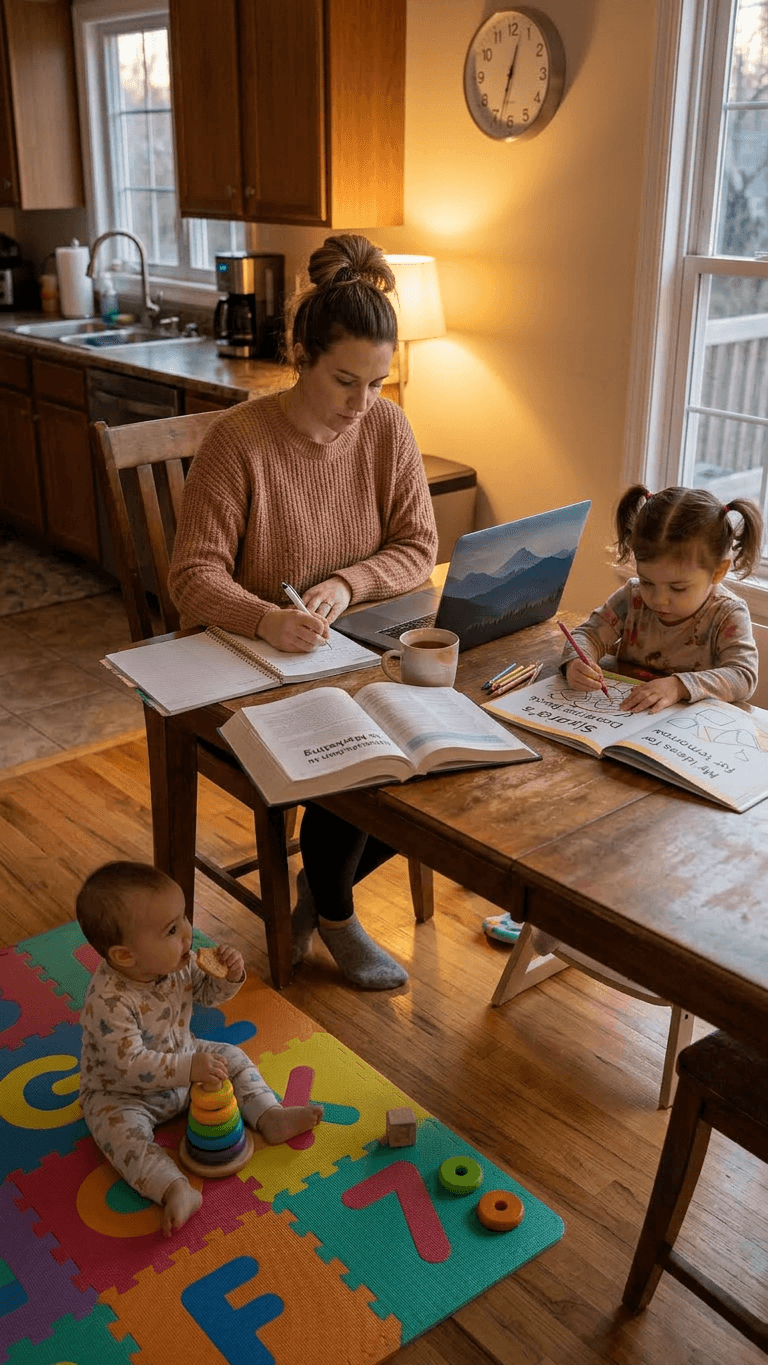
Mental load Netherlands style is the pattern where a mum works three or four days while running the planning, remembering and worrying of the household full time, and CBS data shows that second job is hers in most Dutch families. The Netherlands is the European champion of part time work, and that is often framed as a luxury: free Friday afternoons, school pickup on the bike, no rushed dinners. What the numbers also show is a division of labour where the man works more and the woman takes on more of the care, even though equal is what most parents say they want. The contracted hours shrink. The thinking does not.
Researchers at the University of Bath, publishing in the Journal of Marriage and Family in 2024, found mothers manage 71 percent of household cognitive labour, about 60 percent more than fathers. The Bath team studied US parents, but the Dutch statistics paint the same architecture around it: a mother whose calendar shows part time, and whose head shows nothing of the sort. If that is you, start by naming what you are carrying with a mental load audit, because the Dutch data suggests the problem is structural, not a personal failing of your diary management.
What the Dutch numbers actually say
The CBS and SCP Emancipatiemonitor 2024, the Netherlands official monitor of the position of men and women, is unusually honest about the gap between wish and reality:
- 50 percent of parents with young children want an equal split of paid work and care. Only 9 percent say they actually have one
- 48 percent of parents report the man working more and the woman carrying more of the care, while only 13 percent want that arrangement
- 65 percent of working women in the Netherlands work part time, versus 18 percent of men, and the Netherlands remains European champion of part time work
- For household tasks specifically, 53 percent of women say they do more while their partner works more, while only 38 percent of men describe their household that way
That last number is the mental load in one sentence: the person doing the anticipating can see the imbalance, and the person not doing it genuinely cannot. A mother who has felt gaslit by a partner who sincerely believes things are equal now has a statistics bureau on her side. For the full anatomy of this pattern, read Mental Load Examples: 40 Things Mothers Track That Nobody Sees.
Why does part time work not shrink the mental load?
The theory of the one and a half earner household, the voltijd man plus deeltijd woman in 55 percent of Dutch couples with minor children, is that shorter hours buy recovery time. In practice the free hours are consumed by the invisible work that made the part time arrangement necessary in the first place. CBS found that care for children is a reason to work part time for 97 percent of part time working mothers with children under twelve, versus 91 percent of fathers, and household and shopping tasks are a reason for 89 percent of women versus 67 percent of men.
The part time contract does not come with a part time planning brain. Thursday is not free, it is the day the dentist forms, the playdate logistics and the birthday party gift all queue up. University of Bath research in 2024 quantified why this is exhausting: the anticipating, deciding and checking do not shrink when tasks are shared or outsourced, because delegation itself is cognitive labour. It is why so many Dutch mums describe their day off as busier than a working day, and why How to Explain the Mental Load to Your Partner Without a Fight tends to land differently after showing a partner these tables.
The gap also has a price. The Emancipatiemonitor found that women who had their first child between 2014 and 2016 earned 35 percent less six years later than the year before birth, while men saw no such penalty. Part time hours compound into pensions, promotion odds and financial independence, which is one more quiet weight in the mental load itself: she is doing the maths on all of it.
What full time thinking looks like on a part time week
A Dutch mum invisible list has its own local texture:
- Kinderopvang and gastouder logistics: waiting lists, toeslag paperwork, swap days when the crèche closes for study days
- School admin: the magister portal, surprise themadagen, contribution for Sinterklaas, the fietsencheck before the school cycling exam
- Care coordination: huisarts triage at 8am, the consultatiebureau schedule, grandparent pick-up rotations and their opinions
- Calendar diplomacy: balancing verjaardagen across both sides of the family, arranging opa en oma weekends without offending anyone
- The seasonal spikes: zomervakantie coverage across ten weeks, Sinterklaas surprises, kerst with two families
None of this appears in a job description or a part time contract, which is precisely the point of 8 Types of Mental Load Mothers Carry: most of the load is not the doing, it is the noticing.
How can mums in the Netherlands lighten the load?
Making the invisible visible is the first move, because CBS data shows the biggest predictor of an unfair split is that one partner cannot see it. A structured audit, like the free mental load audit, turns a vague sense of being busy into a list two people can actually divide. The evidence backs specificity: parents who break the load into named, owned items fight less about fairness and hand off more of it completely rather than as instructions.
From there, the levers are boring and effective: a shared family calendar with the cognitive layer written in, not just the appointments; a standing handover moment each week; ownership rather than delegation, meaning one partner owns swimming fully, kit, lesson payments and growth spurts included. And support tools count: AlphaMa is an AI companion for mothers that uses cognitive behavioral techniques to help you run the household layer, from planning the week to drafting the handover to your partner, and it is free right now on the App Store and Google Play in the Netherlands. Dutch mums can use it in the same spirit as the rest of this article: not to work more, but to stop being the only one whose brain is always on.
If the load is sitting on your chest rather than just on your to-do list, treat that as information too. The Trimbos Institute has a free self test for postnatal depression, and your huisarts or the POH-GGZ practice mental health nurse can see you without a hospital referral. For persistent low mood, anxiety or intrusive worry, talk to your huisarts or midwife: support exists, it is covered by your basisverzekering, and asking is the strong move.
The part time trap is not a personal choice problem
It is tempting to solve the Dutch mental load by telling individual women to work more hours or individual men to do more dishes. The CBS data resists both: 70 percent of women say they prefer not to work full time so they keep time for other things, and the load still does not divide itself in the households that choose part time. What moves the needle is making the thinking visible and shared, which is a household project, not a scheduling hack.
The Netherlands built an infrastructure for part time work that most countries envy. The unfinished project is distributing the cognitive labour that comes with it. Until then, the honest summary for Dutch mums is: your contract says 24 hours, your head says full time, and the statistics bureau has noticed.
Related reading:
- Mental Load Checklist: 60 Questions to Find Out What You Are Carrying
- How to Explain the Mental Load to Your Partner Without a Fight
- 8 Types of Mental Load Mothers Carry
Sources
- CBS and SCP, Emancipatiemonitor 2024, chapter Werken en Zorgen, published November 2024: 50 percent of parents want an equal division of work and care but 9 percent have one, 48 percent report the man working more and the woman caring more, 55 percent of couples with minor children are one and a half earners, and first time mothers earn 35 percent less six years after birth https://longreads.cbs.nl/emancipatiemonitor-2024/werken-en-zorgen/
- CBS and SCP, Emancipatiemonitor 2024, chapter Werken, published November 2024: 65 percent of working women work part time versus 18 percent of men, care for children is a part time reason for 97 percent of part time working mothers with children under twelve, household and shopping for 89 percent of women versus 67 percent of men, and 70 percent of women prefer not to work full time https://longreads.cbs.nl/emancipatiemonitor-2024/werken/
- University of Bath, Mothers bear the brunt of the mental load, managing 7 in 10 household tasks, December 2024: Journal of Marriage and Family study of 3,000 US parents finding mothers manage 71 percent of household cognitive labour https://www.bath.ac.uk/announcements/mothers-bear-the-brunt-of-the-mental-load-managing-7-in-10-household-tasks/
- Trimbos Institute, Zelftest postpartale depressie, accessed October 2026: free Dutch self test for postnatal depression symptoms https://www.trimbos.nl/zwangerschap-kraamperiode-en-kinderwens/de-kiem-ik-zwanger/zelftest-pospartale-depressie