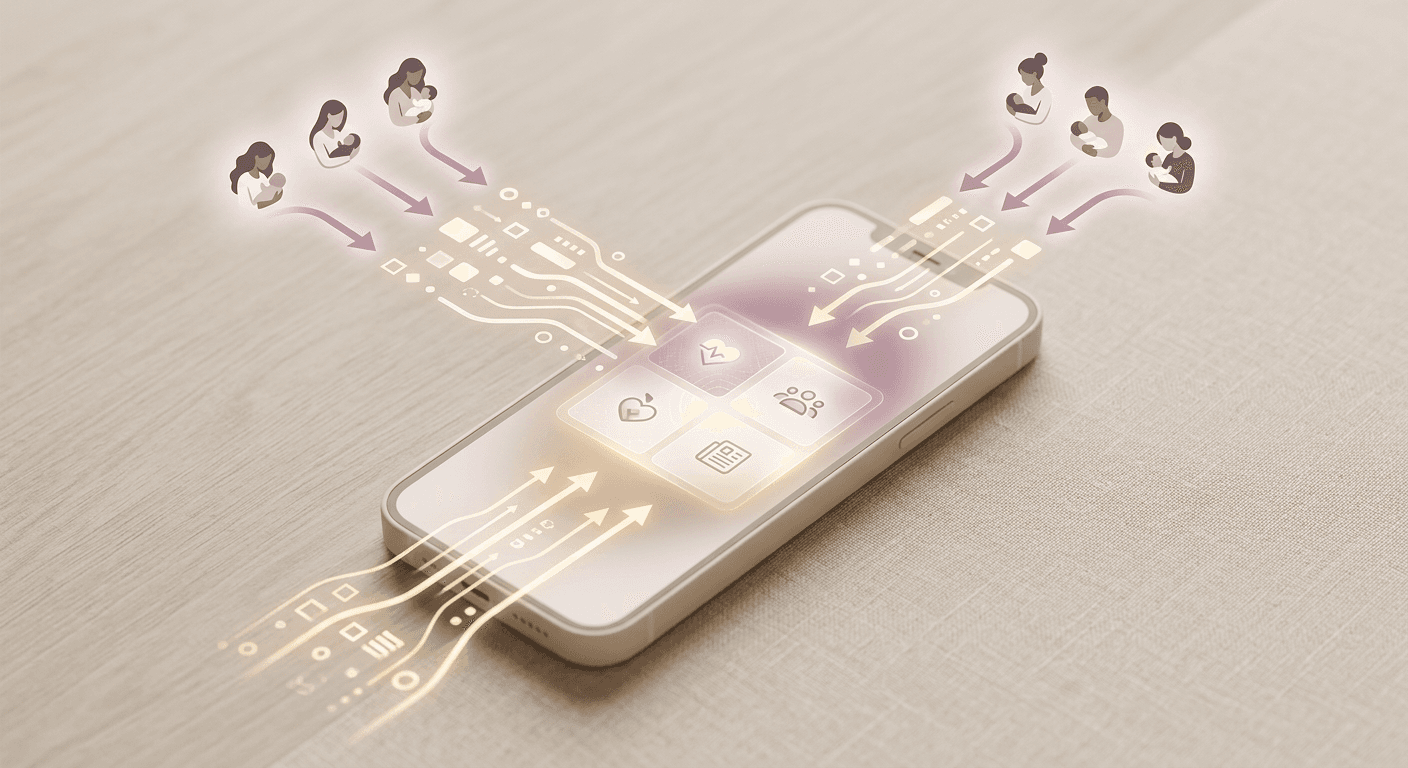
Oura launched a proprietary AI model for women health guidance in February 2026, trained with clinicians and grounded in your own ring data. It is real progress for bodies. It cannot see the 71 percent of household cognitive labor mothers manage, because that number does not live in a heartbeat.
This article is part of the AlphaMa guide to postpartum support.
On February 24, 2026, Oura, maker of one of the most popular smart rings in the world, announced something unusual: not a new sensor, but a new brain. The company built its first proprietary large language model designed specifically for women's health, integrated into the Oura Advisor experience and initially available for testing within Oura Labs. Unlike a generic chatbot bolted onto an app, the model draws on established clinical resources reviewed with clinicians and women's health experts, and it combines that medical knowledge with your personal biometric signals and long-term trends. Ask it about a luteal phase sleep dip or postpartum recovery patterns, and it answers with your data in the frame.
This matters. Women's health questions have historically been answered either by generic health content written for nobody in particular, or by communities where anecdote outruns evidence. An AI model grounded in clinician reviewed sources and individual biometrics is a legitimately better tool. Mothers, who research shows routinely put their own health last, may finally get guidance that meets them where their bodies actually are.
And yet. There is a second crisis in mothers' health that no ring will ever detect, because it produces no biometric signature until it is too late and the signature is called burnout.
Why Traditional Methods Fail
The wearable ceiling. A smart ring measures what happens inside one body: heart rate variability, sleep stages, temperature trends. The mental load is not inside one body. It is a distributed system of appointments, permission slips, grocery inventories, birthday logistics, and the constant low hum of anticipating what breaks next. When University of Bath researchers published in the Journal of Marriage and Family in December 2024 that mothers manage about 71 percent of household cognitive labor, they were measuring a job that spans an entire family ecosystem. Your Oura readiness score can tell you the load is crushing you. It cannot tell anyone that Thursday is Crazy Hair Day.
The tracking paradox. Wearables famously add their own cognitive load: one more metric to check, one more streak to protect. Mothers already spend hours a week worrying about family needs, with survey after survey showing that worry dwarfs time spent on their own health. A device that adds a dashboard to monitor yourself on top of the dashboard you already run for everyone else risks becoming another tab in the browser of your mind.
Insight is not relief. Even the best biometric insight ends with a recommendation directed at you: sleep more, stress less, recover. But if the reason you cannot recover is that you are the family's default operations system, then personalized advice to rest is a message sent to the wrong address. The bottleneck is not your knowledge of your body. It is your monopoly on the family's logistics.
The Cognitive Architecture of the Problem
There are two different information problems hiding under the phrase women's health AI.
The first is a body problem: what is happening inside this one physiological system, cycle after cycle, year after year. This is what Oura's model addresses, and it is the kind of problem biometrics were born for. Signals are continuous, quantifiable, and located on the wrist or finger of the person asking the question.
The second is a household problem: what has to happen, for whom, by when, and who is holding each thread tonight at 10 PM when the camp form is due. This problem has no sensor. It lives in texts, school newsletters, a partner's verbal commitments, and the mother's working memory. It is invisible to every wearable on the market not because the technology is immature, but because the data is scattered across a family rather than concentrated on one body.
This is why mothers keep saying the same thing in every survey about AI: they want it for logistics, not lectures. Research on how families actually use AI assistants keeps finding that the killer use case is not another wellness insight. It is someone else remembering the thing.
So the honest picture of AI for mothers in 2026 is a fork. One branch, exemplified by Oura, watches the mother's body. The other branch needs to watch the family's open loops: the forms, the schedules, the reorder points, the invisible 71 percent. These are not competitors. They are two halves of a mother's health that have been split for no good clinical reason, because chronic overload is a physiological risk factor, and physiology does not care whether the stressor is hormonal or a permission slip.
The AlphaMa Solution: Moving the Burden
AlphaMa sits deliberately on the second fork. It is an AI agent built for family operations: it holds the open loops, tracks deadlines, and nudges the right person at the right time, so the remembering layer stops routing through one default brain. It does not replace a clinician, and it does not read your heart rate variability. Its job is to shrink the load before it ever becomes the kind of chronic stress a ring would measure.
Imagine the two of them working at once. Oura tells you your recovery stalled and your sleep is fragmenting. AlphaMa tells you why, because it moved the school supply hunt, the pediatric dentist booking, and the Saturday birthday gift run off your plate and onto the people and systems that should have been carrying them. Body insight plus burden relief is what whole health for mothers would actually look like.
Oura deserves credit for building AI that finally takes women's bodies seriously. The next frontier is AI that takes mothers' invisible job seriously too. That one will not fit on a ring.
Sources
- ŌURA press release via Business Wire, February 24, 2026: Oura announced its first proprietary large language model designed specifically for women health, integrated into Oura Advisor and initially available for testing in Oura Labs https://www.businesswire.com/news/home/20260224023927/en/URA-Launches-Its-First-Proprietary-AI-Model-to-Deliver-Personalized-Clinically-Grounded-Womens-Health-Guidance
- MobiHealthNews, 2026: the Oura model draws on clinician reviewed medical knowledge and personal biometric data including long-term trends to deliver personalized women health guidance https://www.mobihealthnews.com/news/oura-launches-womens-health-ai-model-powered-biometric-data
- University of Bath, Journal of Marriage and Family, December 2024: mothers manage about 71 percent of household cognitive labor https://www.sciencedaily.com/releases/2024/12/241212150327.htm