Yes, you can develop OCD for the first time after birth. In a new study, 71 percent of mothers with perinatal OCD had no prior history, and 83 percent of new cases began postpartum. It is treatable and far more common than anyone says.
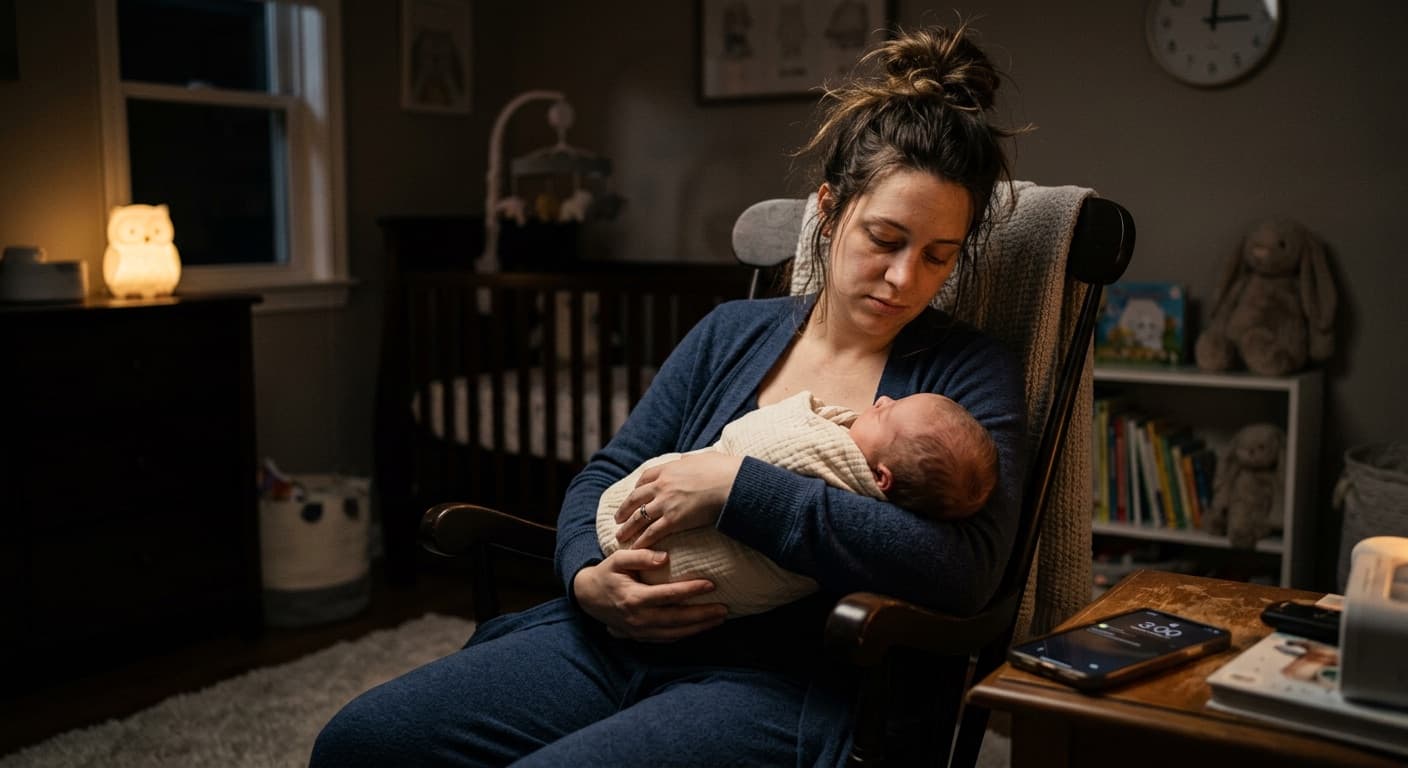
You check that the baby is breathing. You go back to bed. Nine minutes later you are standing over the crib again, counting the rise and fall of her chest, even though you know exactly what you will find. By the third check you are no longer worried about her. You are worried about yourself.
This is the terrain of perinatal obsessive compulsive disorder, and a growing stack of research says it is one of the most common and most missed complications of new motherhood.
In a prospective cohort study in the Journal of Clinical Psychiatry, researchers in British Columbia followed mothers through late pregnancy and two postpartum assessments using structured diagnostic interviews. Among the 97 women who met full criteria for OCD during the perinatal period, over two thirds, 71 percent, had developed the disorder during pregnancy or after birth rather than before it. Onset was over four times more likely to occur postpartum, 83 percent versus 17 percent, and 74 percent of new cases emerged in a woman's first perinatal period. Symptom flares also clustered after birth, with 77 percent of exacerbations landing postpartum compared with 35 percent during pregnancy.
Earlier work by Nicole Fairbrother and colleagues found about 9 percent of mothers reporting new onset OCD after delivery, and a 2025 study in BMC Pregnancy and Childbirth found 15.1 percent of mothers reporting clinically significant OCD symptoms in the postpartum months. Compare that with the 1 to 2 percent of adults who have OCD at any given time and the picture is hard to miss. The year after birth is one of the highest risk windows in a woman's life for developing the disorder.
Why Traditional Methods Fail
The standard postpartum screen, the Edinburgh scale, was built to catch depression. It asks about low mood, loss of pleasure, self blame. It does not ask whether you are checking the stove five times, silently reciting prayers to neutralize a frightening image, or avoiding bathing your baby because the thoughts show up when you do. A mother can pass her screen with flying colors while spending four hours a night in checking loops.
Then there is the silence. Researchers writing in the British Journal of General Practice called perinatal OCD a hidden problem, and the hiding is structural. Mothers with intrusive harm thoughts often believe, wrongly, that telling a provider could get their baby taken away. So the most frightening symptoms are precisely the ones that never make it into the appointment. What the clinician sees instead is a tired, vigilant, devoted mother, which reads as normal.
Even well meaning reassurance backfires. When a partner says the baby is fine, stop worrying, the relief lasts minutes, then the question returns and so does the checking. Reassurance works exactly like a compulsion. It feeds the loop it is trying to close. And because some vigilance is genuinely adaptive in new parenthood, the disorder hides inside a culturally approved costume. Everyone expects a new mother to be watchful, so nobody notices when watchfulness has become a cage.
The Cognitive Architecture of the Problem
Here is what the research suggests is happening. Intrusive thoughts, sudden unwanted images of the baby being harmed, are nearly universal in new mothers. Studies consistently find the large majority of postpartum women experience them. A normal brain files the thought as noise and moves on. A brain sliding toward OCD files the thought as evidence, concludes that the thought itself is dangerous, and recruits behavior to neutralize it. Check again. Wash again. Ask again. Avoid the stairs, the knives, the bath, the story unfolding in your own head.
Each neutralization buys a few minutes of relief and teaches the brain that the thought was a real emergency, which makes the next one louder. That is the engine of OCD, and the postpartum period supplies it with premium fuel: collapsing sleep, plummeting hormones, and a threat system that evolution has deliberately turned up. The British Columbia team found the lag between first symptoms and full disorder was shorter when onset was perinatal, meaning escalation here is fast. A mother can go from occasional strange thoughts to a rigid checking architecture in a matter of weeks.
Two details deserve a headline. First, first pregnancies are disproportionately where this appears, so the mother with no reference point for what normal feels like is the one most at risk. Second, perinatal OCD travels with depression. The BMC study found substantial overlap between OCD symptoms and depressive symptoms, which means a mother being treated for depression may still have an untreated compulsion layer no one has named.
One crucial distinction: OCD is not psychosis. A mother with OCD is horrified by her thoughts, does not believe them, and wants them gone. Her insight is intact, which is exactly why the shame is so crushing. If you are terrified of your own thoughts, that terror is diagnostic good news. It means some part of you already knows the thoughts are not you.
The AlphaMa Solution: Moving the Burden
Perinatal OCD is among the most treatable perinatal mental health conditions. Exposure and response prevention, the gold standard psychotherapy, works well in the postpartum months, and first line options like sertraline are considered compatible with pregnancy and breastfeeding. The hard part is not the treatment. It is the distance between the first silent check and the first spoken sentence about it, and mothers close that distance far later than they should.
That distance is where the burden has to move off the mother. Something that sits inside the daily noise of motherhood can notice the pattern before you have words for it, the three AM loops, the repeated reassurance asks, the quiet spread of avoidance, and can name it gently and point toward real care instead of another night of private catastrophizing. That is part of what AlphaMa is for. It carries the planning and remembering that floods a tired brain, tracks patterns a mother is too close to see, and treats what you report about your own mind as information worth acting on, never as something to hide.
If the checking has grown teeth, say it out loud to someone this week. Seventy one percent of the mothers in that cohort had never had OCD before. You are not a different, worse person than the one who got pregnant. You have a common, documented, treatable perinatal condition, and it responds to help.
Sources
- Perinatal Timing of Obsessive Compulsive Disorder Onset. Journal of Clinical Psychiatry, 2024;85(3):24m15266, published online May 2026. Prospective British Columbia cohort, N=97 mothers with full criteria OCD. 71 percent perinatal onset, 83 percent postpartum onset versus 17 percent pregnancy, 74 percent first perinatal period, exacerbations 77 percent postpartum versus 35 percent prenatal. https://www.psychiatrist.com/jcp/perinatal-timing-of-obsessive-compulsive-disorder-onset/
- Fairbrother N, Collardeau F, Albert AYK, et al. High prevalence and incidence of obsessive compulsive disorder among women across pregnancy and the postpartum. J Clin Psychiatry 2021. About 9 percent of mothers reported postpartum onset of OCD. https://www.psychiatrist.com/jcp/high-prevalence-ocd-across-pregnancy-and-postpartum/
- MGH Center for Women Mental Health (2021). High Prevalence of OCD in Pregnant and Postpartum Women. https://womensmentalhealth.org/posts/high-prevalence-of-ocd-in-pregnant-and-postpartum-women/
- BMC Pregnancy and Childbirth (February 2025). OCD symptoms during pregnancy and postpartum: prevalence, stability, predictors, and comorbidity with peripartum depression symptoms. 15.1 percent OCD symptoms in pregnancy and 15.1 percent postpartum, with 9.8 percent at both timepoints. https://bmcpregnancychildbirth.biomedcentral.com/articles/10.1186/s12884-025-07302-y
- Challacombe FL, Wroe AL. A hidden problem: consequences of the misdiagnosis of perinatal obsessive compulsive disorder. Br J Gen Pract 2013. https://pubmed.ncbi.nlm.nih.gov/23643226/
- MGH Center for Women Mental Health (August 7 2026). Weekly Roundup: perinatal OCD onset during pregnancy and postpartum with multiple obsession and compulsion types. https://womensmentalhealth.org/posts/weekly-roundup-august-7-2026/
- Forray A, Focseneanu M, Pittman B, et al. Onset and exacerbation of obsessive compulsive disorder in pregnancy and the postpartum period. J Clin Psychiatry 2010. https://pubmed.ncbi.nlm.nih.gov/20492843/
- Center for Anxiety and Behavior Therapy (2026). Perinatal OCD prevalence about 3 percent in pregnancy and up to 7 percent postpartum versus 1 to 2 percent in the general population. https://www.centerabt.com/blog/mothersday-perinatal-ocd