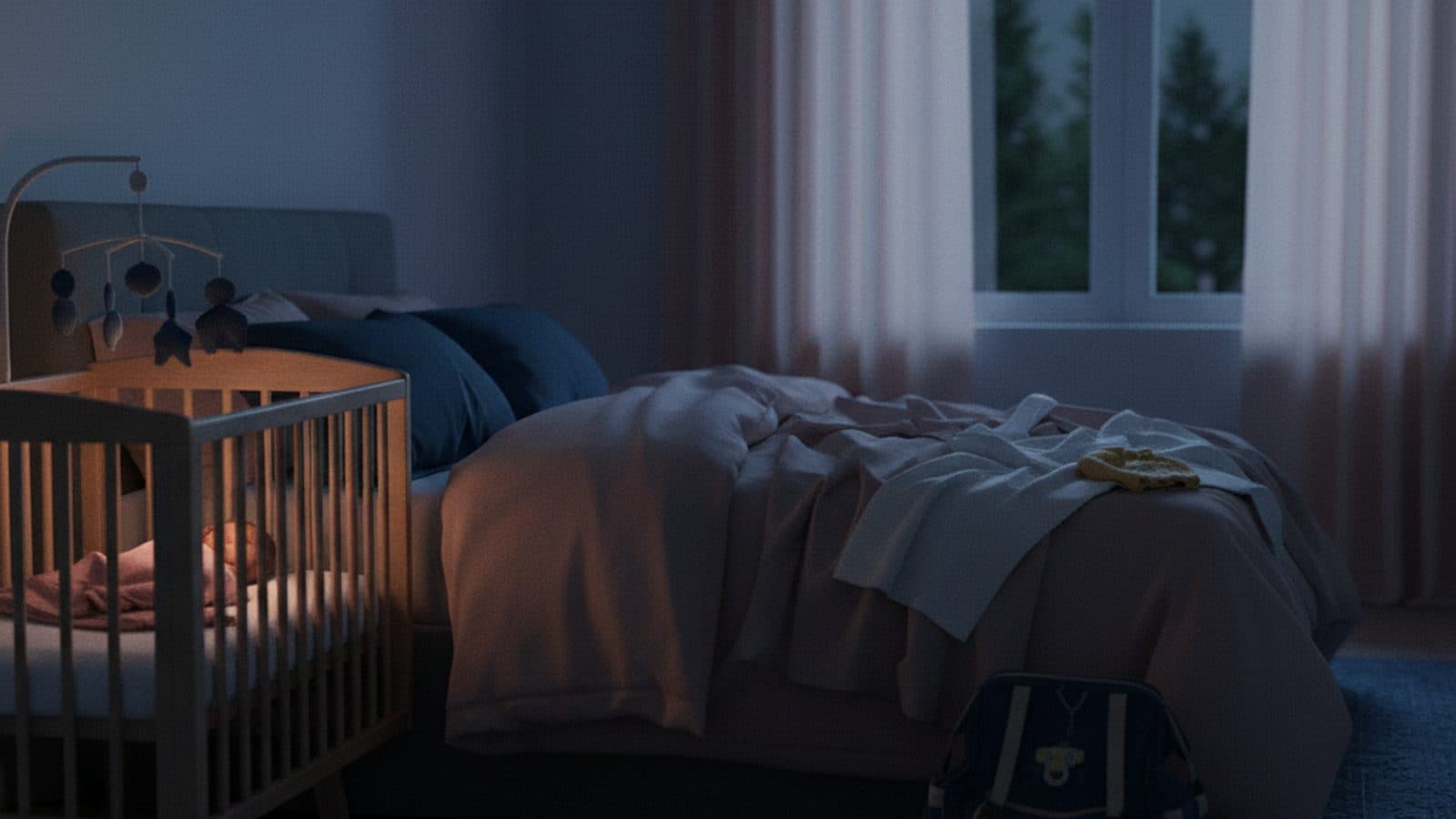
Postpartum psychosis affects up to 2 in 1,000 new mothers and is a medical emergency. New coverage of a Massachusetts trial shows why it gets missed: no screening tool, no distinct DSM diagnosis, symptoms that mimic normal new motherhood. The earliest red flag is usually insomnia.
This article is part of the AlphaMa guide to postpartum support.
Here is the sentence that should stop a family cold in the first month after a birth. Not "she seems exhausted." Every new mother is exhausted. The sentence is this: she finally has the chance to sleep, and she still cannot.
A murder trial in Massachusetts has put postpartum psychosis in headlines this month, and whatever anyone thinks of the case itself, the clinical picture experts described in the coverage is something every family with a new baby should understand. Up to 2 in every 1,000 mothers develop postpartum psychosis after childbirth. It is rare. It is also the most severe mental health emergency associated with childbirth, and studies cited in the coverage show that untreated it carries a roughly 4 percent risk of infanticide and a 5 percent risk of suicide. About 90 percent of episodes begin within four weeks of the birth. Those first four weeks are exactly when everyone is watching the baby and assuming the mother is simply tired.
Mental health conditions are already the most common complication of pregnancy and parenting, affecting as many as 1 in 5 women in the United States, and they are the leading underlying cause of pregnancy related death. Postpartum psychosis is the rarest, sharpest edge of that crisis, and the system we have is built in a way that almost guarantees we find it late.
Why Traditional Methods Fail
We have decent screening questionnaires for postpartum depression and anxiety. We have nothing for psychosis. Dr. Nicole Leistikow, clinical director of the Johns Hopkins Reproductive Mental Health Center, put it plainly: we really do not have a tool that says boom, you have postpartum psychosis.
Three failures stack on top of that gap.
First, the system relies on self report, and this illness attacks self report. A 2024 study found that women with postpartum psychosis often do not recognize that anything is wrong, because the illness itself disconnects them from reality. A screening model that waits for the mother to raise her hand cannot catch a condition whose defining feature is not knowing your hand should be raised.
Second, it is not even a distinct diagnosis in the DSM, the manual clinicians use to classify mental illness. As forensic psychiatrist Susan Hatters Friedman told WBUR, postpartum psychosis is folded in under other diagnoses rather than standing on its own, which means clinicians are not systematically trained to hunt for it and researchers have no clean category to study. You cannot screen well for something the field has not fully named.
Third, the course of the illness defeats the appointment model. Dr. Lauren Osborne of Weill Cornell Medicine describes symptoms that wax and wane: delusions are often more subtle than hallucinations, and a woman can seem fine in the morning and be in crisis that night. A ten minute checkup can miss it entirely, and then everyone concludes the evaluation was reassuring.
And when suspicion does arise, accepting care is terrifying. Treatment usually means hospitalization, and mother baby units remain rare in the United States. "What new mother is willing to risk separation from her infant?" Leistikow asked. "That's incredibly scary and makes it much more difficult for women to come forward." So the mother who most needs emergency care is often the one most motivated to hide.
The Cognitive Architecture of the Problem
Step back and look at the design of this failure, because it functions as nearly perfect camouflage.
The condition disables exactly the faculty needed to detect it: insight. Then it wears the costume of normal new motherhood. Insomnia, anxiety, irritability, overwhelm, racing thoughts about the baby's safety. All of these are expected in a new mother, so no alarm sounds. The symptoms hide inside the stereotype.
The monitoring burden then falls on the two least equipped parties in the room. The mother cannot self monitor, by definition. The partner has never been taught what to watch for, because nobody is taught. Grandmothers compare everything to their own foggy memories from decades ago. The pediatrician watches the baby. The six week checkup is weeks away. The window when 90 percent of episodes begin, the first month, is precisely the window with the least adult attention on the mother's inner state.
Underneath all of it sits a biological trigger nobody plans around: sleep. A history of sleep loss triggering mania sharply raises risk, and the postpartum weeks are the most sleep fragmented stretch of a woman's life. Night feeds default to the mother, fragments accumulate, and no one ever stops to check the one signal that matters: when she is finally given the chance to sleep, can she? Leistikow described the difference a support network makes by watching for exactly that, a mother who is given the opportunity to sleep but still cannot sleep, so clinicians can step in and treat the insomnia before that spark becomes a fire.
The problem is not that families are careless. The problem is that detection was assigned to a person and a schedule that cannot hold it.
The AlphaMa Solution: Moving the Burden
The protocol experts describe is not complicated. It is structural.
Connect with a mental health provider during pregnancy, especially with any history of bipolar disorder, a previous episode, or a family history, and establish a baseline before the birth. Plan sleep before the baby arrives, in writing, with a named responsible adult covering night feeds so the mother gets a protected block of four to six hours. Teach the partner the specific red flags in advance: sleep that will not come even when given the chance, appearing fine one minute and not fine the next, beliefs that quietly stop making sense, a mood that will not settle. Then have someone check in on the mother, not the baby, weekly through the first month.
Every piece of that is the same move: shifting the burden of vigilance out of the mother's exhausted head and into a system around her. A mother in the first postpartum month should not be responsible for catching her own medical emergency. The watch has to live somewhere else.
That is the layer AlphaMa is built to add: a companion that knows a mother's baseline before birth, notices when the nights stop working, translates the warning signs into plain language for the people around her, and escalates to real human help when the pattern turns. Not diagnosis. Watchfulness that does not depend on her being the one who notices.
If you are worried about yourself or someone you love after a birth, do not wait for certainty. Call or text 988 in the United States, reach Postpartum Support International at postpartum.net, and treat any break with reality after childbirth as the emergency it is.
Sources
- Christensen J. The Lindsay Clancy trial brings maternal mental health into the spotlight. CNN Health. August 13, 2026. https://www.cnn.com/2026/08/13/health/postpartum-psychosis-maternal-mental-health
- WBUR. Clancy trial highlights postpartum psychosis and barriers to care for mothers. August 12, 2026. https://www.wbur.org/news/2026/08/12/massachusetts-lindsay-clancy-murder-children-delusions-maternal-care
- Cleveland Clinic. Postpartum Psychosis. https://my.clevelandclinic.org/health/diseases/24152-postpartum-psychosis
- Postpartum psychosis presentation, assessment and management review, 2024. https://pmc.ncbi.nlm.nih.gov/articles/PMC11058913/
- Sleep loss and risk of postpartum psychosis and postpartum mania. https://pmc.ncbi.nlm.nih.gov/articles/PMC10744103/