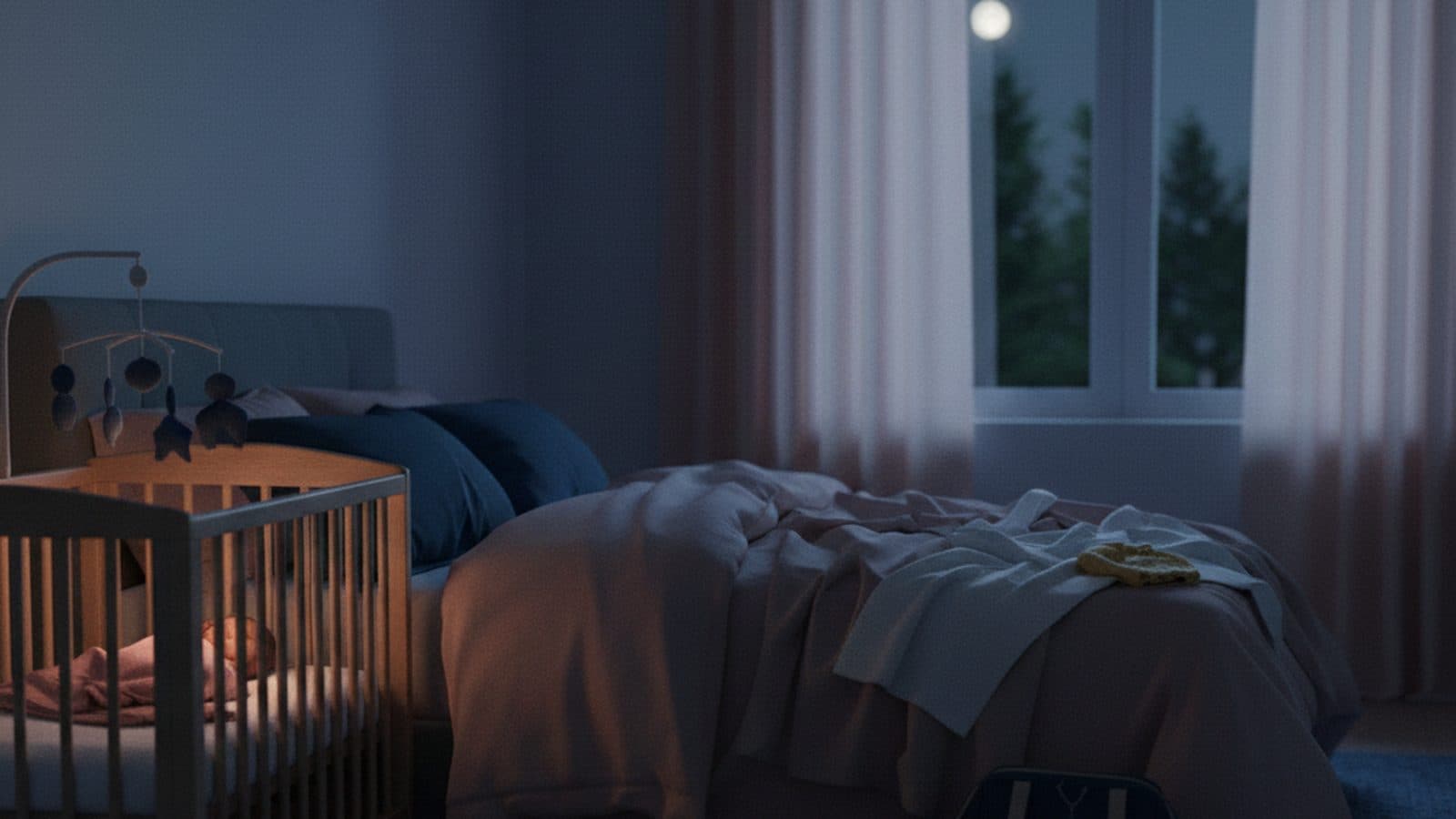
Stay at home mom burnout is exhaustion caused by running a home and raising children alone all day, with no coworkers, no break that actually breaks, and no clock out time. It is not laziness, and it is not ingratitude for the years you wanted. It is what happens to a person who is on duty from the first cry to the last bedtime stall, every day, with nobody handing anything back.
The standard advice misreads it. You are told to wake up before the kids, meal prep on Sundays, and take time for yourself, which adds three tasks to the person who already has none left. The real problem is the shape of the day itself. If you want the deeper map of that shape, start with our guide to mom burnout, because the stay at home version is the same disease with one extra symptom: the office and the recovery room are the same building.
What does stay at home mom burnout look like?
The Ohio State University College of Nursing and Office of the Chief Wellness Officer surveyed 1,285 parents in May 2022 and found 68 percent of working mothers showed signs of burnout. Mothers at home full time were not spared in that research, and later surveys found the same exhaustion without a paycheck attached. The Ohio State Wexner Medical Center ran a national survey of 265 parents in April 2024 and found 62 percent felt burned out by their responsibilities as a parent, 66 percent found parenting isolating or lonely, and 38 percent felt they had no one supporting them in the parenting role at all.
Read that last number again. Nearly 4 in 10 parents have nobody in their corner, and isolation at home is the default setting of the job. The picture that emerges is not a woman who cannot cope. It is a woman running a solo operation with no colleagues, reviewed by no one, praised by no one, and never off the clock.
Why being home all day is the problem, not you
Burnout research has always been clear on this point: exhaustion comes from demands without control or recovery. A paid job has built in recovery structures. There is a commute that ends, a lunch that belongs to you, colleagues who take over when you are sick. The stay at home day has none of that, because your workplace is also where you sleep, eat, and are supposed to relax.
The U.S. Bureau of Labor Statistics American Time Use Survey, 2018 results, measured the raw difference. Among adults living with children under age 6, those who were not employed spent 2.8 hours a day on primary childcare, over an hour more than the 1.7 hours spent by employed adults. That is only the counted activity. It does not include supervising while cooking, or the 11pm mental scan of tomorrow, which is the part that actually erodes you. The University of Bath and University of Melbourne study in the Journal of Marriage and Family, 2024, surveyed 3,000 U.S. parents and found mothers handle 71 percent of household cognitive labor, rising to 79 percent for daily tasks like childcare and meal planning. So the mother at home full time is not just doing more hands on care. She is also doing nearly all of the invisible planning that the care runs on.
Is being a stay at home mom harder than a full time job?
Harder is the wrong axis, but in one specific way the answer is yes: it is unending. A full time job trades your hours for structure, income, identity, and adult conversation. The day at home trades all of those for presence, and presence without relief becomes depletion. Researchers call the mechanism cognitive labor, and we break down what it means for mothers who feel it but cannot name it in what mental load actually is.
Here is the part you can screenshot. A day at home is structurally exhausting because it has:
- No transition: the commute home does not exist, so you never change modes
- No colleagues: 66 percent of parents in the Wexner survey found it isolating
- No review cycle: nobody sees the twenty invisible decisions before lunch
- No end state: the laundry and dishes reset to zero daily
- No pay, and with it, no socially recognized proof that you worked
Any one of those is survivable. All five, seven days a week, is how a capable mother ends up crying in the pantry.
What actually helps when you cannot leave the house
Self-care that adds tasks is not care. What helps is anything that removes load or adds people, in roughly this order.
First, make the invisible countable. Our mental load calculator turns the hum of things you are tracking into a list you can hand to someone else. Most partners are not refusing to help, they genuinely cannot see what needs doing, and a countable list ends that argument.
Second, rebuild adult contact on purpose. The Wexner survey found 79 percent of parents would value a way to connect with other parents outside work and home, which is most of you reading this. One standing weekly walk with another mother does more for this kind of exhaustion than any app, because loneliness is the load multiplier here.
Third, transfer ownership, not tasks. If he does bedtime, he owns bedtime: the routine, the pajama inventory, the sheet washing. Delegating while still monitoring is the worst of both worlds, a pattern we explain in why delegating tasks does not reduce the mental load.
Fourth, get structured support for the thinking itself. AlphaMa is an AI companion for mothers that helps you plan, track, and offload the running list, using cognitive behavioral techniques to untangle the 11pm thought spirals that come with a day that never ended. If your exhaustion has crossed into the signs described in burnout signals nobody talks about, that is the moment to act, and it is free right now.
When it is more than burnout
Burnout lifts when the load drops. Depression does not. If you have cut the load, slept, and still feel flat, numb, hopeless, or unable to enjoy your children for more than two weeks, that is a medical question, not a scheduling one. Talk to your doctor or midwife, say the words out loud in the appointment, and let them screen you. In the United States and Canada you can call or text 988 for mental health crisis support any hour. If you ever have thoughts of harming yourself or your baby, that is an emergency, not a failing, and you should be seen the same day. How long this lasts depends on whether the load actually changes, which we walk through in how long burnout lasts.
The guilt says you chose this, so you forfeit the right to be tired. Reject it. You chose to raise your children. You did not choose to do the thinking for four people, alone, in a building you can never leave.
Related reading:
- What is the mental load in motherhood?
- Why delegating tasks does not reduce the mental load
- How long does burnout last?
Sources
- The Ohio State University Office of the Chief Wellness Officer and College of Nursing, Working Parent Burnout report, May 2022: 68 percent of working mothers and 42 percent of working fathers showed signs of burnout among 1,285 parents surveyed https://wellness.osu.edu/resources/parent-burnout
- U.S. Bureau of Labor Statistics, American Time Use Survey 2018 results, news release June 19 2019: adults living with children under age 6 who were not employed spent 2.8 hours per day caring for household children versus 1.7 hours for employed adults https://www.bls.gov/news.release/archives/atus_06192019.htm
- The Ohio State University Wexner Medical Center, national survey of 265 parents, April 2024: 62 percent feel burned out, 66 percent find parenting isolating, 38 percent lack support, 79 percent want parent connection https://wexnermedical.osu.edu/mediaroom/pressreleaselisting/new-survey-finds-loneliness-epidemic-runs-deep-among-parents
- University of Bath and University of Melbourne, Journal of Marriage and Family, 2024: mothers handle 71 percent of household cognitive labor tasks and 79 percent of daily childcare and meal planning tasks among 3,000 U.S. parents https://www.bath.ac.uk/announcements/mothers-bear-the-brunt-of-the-mental-load-managing-7-in-10-household-tasks/