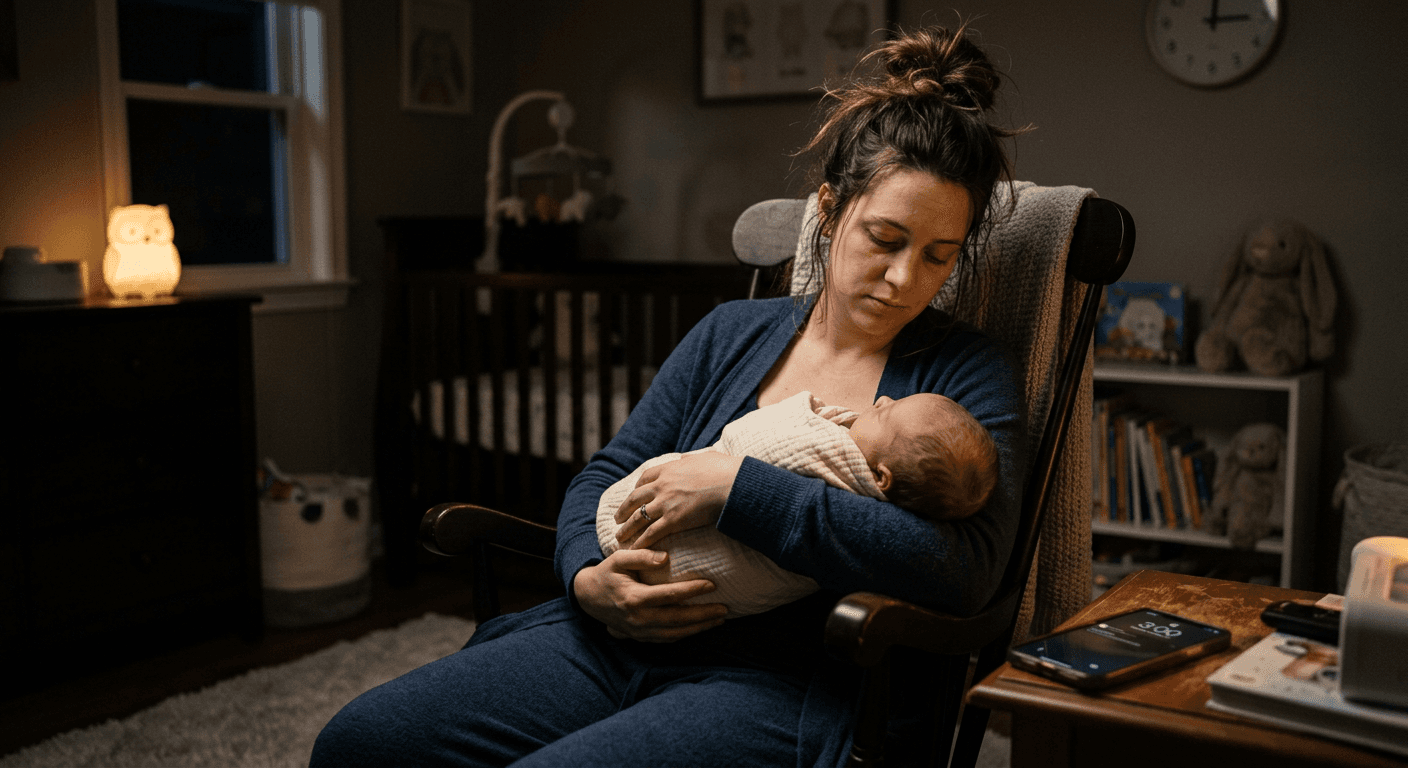
The first six weeks after birth are supposed to be about bonding, recovery, and figuring out feeding. For most mothers, they are also about isolation, unanswered questions, and a mental health spiral that nobody catches because the four week checkup got skipped or never got scheduled.
This article is part of the AlphaMa guide to postpartum support.
A new clinical study released August 3 at the Pediatrics Academic Societies Conference offers something mothers rarely get from postpartum care research: measurable proof that continuous virtual support reduces anxiety and depression, not just feeding problems.
Mothers who completed three or more virtual lactation consultations through SimpliFed breastfed for an average of 15.9 additional weeks and showed measurable reductions in GAD 7 and PHQ 9 anxiety and depression scores over 12 months. Among mothers with existing mental health conditions, those with three or more visits breastfed an average of 38.9 weeks compared to 14.5 weeks without support.
Why Traditional Methods Fail
The standard postpartum care model in the United States is built around scarcity. You get a six week checkup. Maybe a two week visit if you had complications. If breastfeeding is struggling, you might get one in hospital lactation consult before discharge, a pamphlet, and a phone number for a WIC office that may or may not call you back.
The Aeroflow study released in July 2026 quantified what mothers already know. Respondents cited childcare, transportation, scheduling difficulties, limited in network access, and lack of awareness about appointments as the primary barriers to completing postpartum care. The system asks mothers to travel to appointments, arrange childcare, take time off work, and find providers who accept their insurance, all while recovering from childbirth and caring for a newborn.
This model treats postpartum support as an event. Show up at six weeks. Get cleared. Move on. But postpartum mental health does not follow a six week schedule.
The Independent reported on August 3 that one in eight women experiences antenatal anxiety during pregnancy, and experts believe the numbers are rising. Dr. Nina Memarnia, a perinatal psychologist, told the publication: "Naturally, there is a lot of anxiety for mothers now as they are holding a lot more than their parents held. There is also an exposure to more information with social media, and women hear in the news about the state of maternity services so it is no wonder they are anxious about giving birth."
Anxiety that begins during pregnancy does not resolve at birth. It shifts. It attaches to new fears, new responsibilities, new sleep deprivation. And the care system is not designed to catch it.
The Cognitive Architecture of the Problem
Postpartum mental health decline has a specific architecture that researchers are finally mapping with precision.
The support cliff. After birth, the support infrastructure drops sharply. Partners return to work within days or weeks. Family visitors leave. The meal trains end. But the cognitive demands of motherhood intensify. The mother is now responsible for feeding schedules, sleep training debates, pediatrician appointments, her own recovery, and the continuous monitoring of a tiny human who cannot communicate what is wrong. The delta between what mothers are asked to carry and the support available to them is the postpartum mental health crisis.
The screening gap. The healthcare system relies on the Edinburgh Postnatal Depression Scale, a 10 question survey administered at the six week visit. But anxiety during pregnancy affects one in eight women according to NICE, and up to one in five women experience perinatal anxiety across the full spectrum according to NIH research. The screening tools were designed for depression, not anxiety. And they are administered at a single time point, missing the mothers who spiral at week three or week ten.
The access architecture. The Aeroflow study identified five structural barriers to postpartum care: childcare, transportation, scheduling, network limitations, and awareness. These are not personal failings. They are design failures in the care system. When a mother cannot get to a lactation consultant because she does not have childcare for her toddler and the clinic is 40 minutes away, the problem is not her motivation. The problem is the system.
The mental load amplifier. Research from Weeks and Ruppanner published in the Journal of Marriage and Family found that mothers carry roughly 71 percent of household cognitive labor. In the postpartum period, this load does not decrease. It compounds. The mother is tracking feeds, diapers, sleep, milestones, medication schedules, her own symptoms, and the household operations that did not pause for birth. When mental health struggles emerge, they emerge inside an already overloaded cognitive system.
The UMass Chan and SimpliFed Evidence
The SimpliFed study led by UMass Chan Medical School is significant because it measured outcomes across a full 12 month period, not just a single intervention point.
Researchers evaluated breastfeeding practices, maternal mental health, and healthcare utilization among participants who received access to both scheduled and on demand virtual lactation consultations. The findings were striking.
Across all study participants, 96.2 percent reported feeding any breastmilk at one week postpartum, 73.1 percent by six months, and 57.6 percent by 12 months. Compare that to national data from the CDC showing that only one in four infants is breastfed for the recommended duration. The gap between the study population and national rates is enormous.
The dose response relationship was the critical finding. Participants who completed three or more telelactation visits breastfed for an average of 15.9 additional weeks compared to those who did not engage. For mothers with mental health conditions, the effect was even more dramatic: 38.9 weeks of breastmilk feeding with three or more visits versus 14.5 weeks without.
And the mental health improvements were not secondary observations. They were measured using GAD 7 (Generalized Anxiety Disorder) and PHQ 9 (Patient Health Questionnaire) assessments over time. More virtual support visits were associated with greater reductions in anxiety and depression symptoms.
Andrea Ippolito, CEO and founder of SimpliFed, said: "The SimpliFed and UMass Chan study highlights the role that accessible, continuous postpartum support can play in improving outcomes for families during one of the most critical periods of the maternal health journey."
The mechanism is straightforward. When mothers have continuous access to specialists who can answer questions, address feeding challenges before they escalate, and provide a consistent touchpoint throughout the first year, their anxiety decreases. Their confidence increases. They stop spiraling at 3 AM alone with a fussy baby and a lactation problem they cannot solve.
The Broader Femtech Investment Picture
The SimpliFed data lands inside a femtech funding environment that is accelerating. FutureFemHealth reported in late July that July 2026 surpassed June for funding announcements.
The same week as the SimpliFed study, DITTO, a menstrual health supplement startup, raised a $6 million seed round led by FoodLabs and Eka Ventures with a research focused approach to PMDD and PMS. Elle MD in Canada raised C$1.1 million for a hormone free contraceptive ring device now entering clinical testing. The American Baby Company raised $4 million to expand affordable IVF, offering full cycles including medications for $8,995. SPRIND in Germany selected eight teams for a 40 million euro continuous hormone monitoring challenge, including Level Zero Health, Molesense, and Impli.
Becker's Hospital Review named 272 telehealth companies to know in 2026, including Nest Collaborative, described as the first and largest virtual lactation platform providing same day virtual consults seven days a week. Maven Clinic continues to expand its model, offering over 30 types of specialists with appointments available within an hour, including at 2 AM for a breastfeeding crisis.
The capital is flowing toward continuous, on demand, virtual maternal care. The SimpliFed study gives that capital a clinical evidence base.
The AlphaMa Solution: Moving the Burden
The evidence is converging on a single conclusion. Maternal mental health improves when support is continuous, accessible, and does not require mothers to leave their homes, arrange childcare, or wait six weeks for an appointment.
AlphaMa was designed for the gap between appointments. The companion is available at 3 AM when the feeding questions surface. The mental load tracking surfaces anxiety patterns before they become crises. The partner features ensure that postpartum support is not another thing the mother has to manage alone.
You should not have to schedule a clinical visit to get help with breastfeeding. You should not have to carry the mental health consequences of an unsupported postpartum period because the system was designed for a world that no longer exists. AlphaMa is building the continuous support layer that the research now proves mothers need.
Sources
- SimpliFed and UMass Chan Medical School interim results, Pediatric Academic Societies, August 3 2026: virtual lactation support linked to longer breastfeeding and lower GAD 7 and PHQ 9 scores https://www.globenewswire.com/news-release/2026/08/03/3337275/0/en/interim-results-from-a-clinical-study-evaluating-the-impact-of-virtual-lactation-support-through-simplifed-on-maternal-health-and-breastfeeding-success-outcomes-released-at-pediatr.html
- Aeroflow Health, July 23 2026: why mothers miss postpartum care, childcare, transportation, scheduling and awareness barriers https://www.globenewswire.com/news-release/2026/07/23/3332357/0/en/aeroflow-health-s-independent-research-identifies-why-mothers-miss-postpartum-care-and-what-health-plans-can-do-about-it.html
- The Independent, August 3 2026: one in eight women experience antenatal anxiety per NICE https://www.independent.co.uk/life-style/health-and-families/antenatal-anxiety-pregnancy-motherhood-mental-health-b3022389.html
- Fawcett and colleagues, meta analysis 2019: anxiety disorders affect roughly one in five women during pregnancy and postpartum https://pubmed.ncbi.nlm.nih.gov/31347796/
- CDC Breastfeeding Report Card: about one in four infants exclusively breastfed through six months https://www.cdc.gov/breastfeeding-data/breastfeeding-report-card/index.html
- University of Bath via ScienceDaily, December 2024: mothers manage about 71 percent of household cognitive labor, Journal of Marriage and Family https://www.sciencedaily.com/releases/2024/12/241212150327.htm
- FutureFemHealth, July 29 2026: four new funding rounds including DITTO, Elle MD and American Baby Company https://www.futurefemhealth.com/p/four-new-funding-rounds-sprind-finalists
- Becker's Hospital Review, July 17 2026: 272 telehealth companies to know https://www.beckershospitalreview.com/healthcare-information-technology/272-telehealth-companies-to-know-2026/