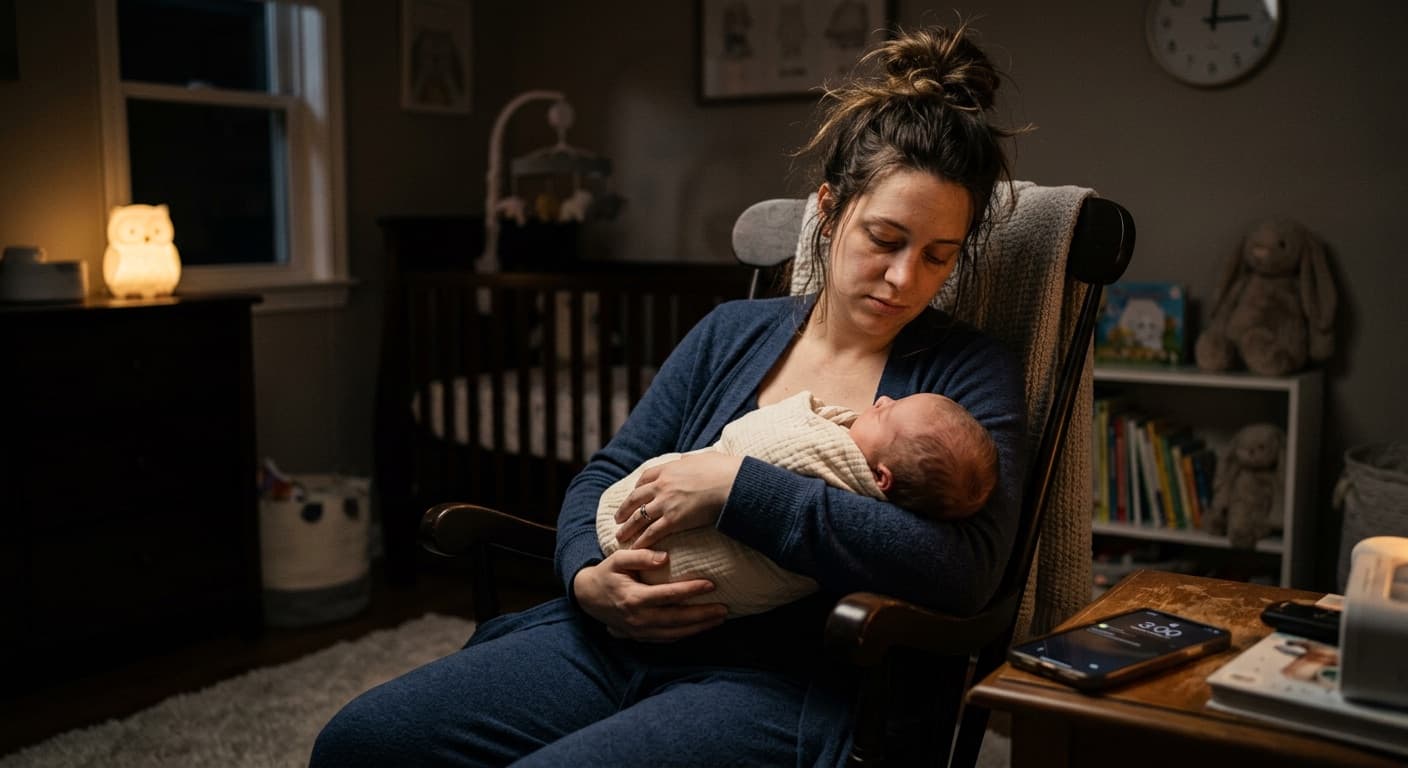
Postpartum insomnia is trouble falling asleep or falling back asleep after birth even when the baby is down, the room is dark, and you are exhausted, and researchers now treat it as one of the clearest early warnings of postpartum mood symptoms. The scenario is almost comic in how consistent it is: nine weeks in, the baby finally does a four hour stretch, and you lie there listening to the monitor, composing tomorrow grocery list and replaying a conversation from 2019. In a study of 159 women followed monthly through the first six months after birth, published in Psychosomatic Medicine in October 2023 by Michele Okun and Andrew Lac, about 20.4 percent met the criteria for insomnia and 67.8 percent had poor sleep quality, and the sleep problems predicted later depression and anxiety symptoms even after controlling for sleep during pregnancy.
That last part matters. It was not how badly they slept while pregnant that forecast their mood. It was how they slept after the baby arrived. So if your nights are falling apart now, that is not a footnote to the postpartum period. It is a core part of postpartum support that deserves the same attention as feeding and recovery, and it is worth naming out loud to your provider instead of shrugging it off as just how it is now.
What Is Postpartum Insomnia, Exactly?
It helps to separate two things that get lumped together. Fragmented sleep is waking because the baby wakes: feed, settle, back to bed. That is normal infant life, and it improves as the baby consolidates sleep. Insomnia is a disorder of your own sleep machinery: you cannot fall asleep when you have the chance, you wake at 3am and cannot return, or you sleep but wake unrefreshed, at least three nights a week for a month or longer.
The numbers say both are common, but insomnia proper is its own animal. A meta-analysis of 42 studies published in Frontiers in Psychiatry in 2020 found 67.2 percent of postnatal women had poor sleep quality on the Pittsburgh Sleep Quality Index, while other research cited in that same paper put clinically significant insomnia symptoms as high as 87.5 percent in postpartum women in some samples. Poor quality is nearly universal. Insomnia that persists month after month is the subset that predicts trouble, and it is the subset worth acting on.
Why Can You Not Sleep Even When the Baby Sleeps?
A few mechanisms stack, and knowing them helps because each one has its own countermove.
Hyperarousal is the engine. Postpartum mothers run with the threat detection system dialed up: part of your brain stays on sentinel duty for the baby, and that vigilance does not switch off just because the monitor is quiet. Researchers describe insomnia as a 24 hour condition of heightened arousal, not just a nighttime problem.
Sleep debt scrambles the architecture. Weeks of broken sleep followed by a sudden long stretch can trigger a rebound of light, restless sleep, so the first night the baby finally sleeps, you paradoxically sleep worse.
Hormones are still moving. Progesterone, which supports sleep, drops sharply after birth, and if you are pumping or feeding around the clock, prolactin and cortisol rhythms stay flattened.
The racing mind is the mask it wears. Research on postpartum anxiety describes intrusive worry loops about SIDS, breathing, schedules, and your own adequacy. If your nights are loud with catastrophic what ifs and your days are tense, read the overlap carefully in postpartum anxiety vs depression, because the treatments point in different directions.
And rarely, the sleeplessness is a red flag. If you have gone several nights with little or no sleep, feel speeded up or strangely energized, or have beliefs that do not hold up to daylight, that can be the edge of postpartum psychosis, which is a medical emergency. Know the warning signs doctors sometimes miss and treat sleep loss that severe as a reason to call your provider the same day.
When Does Postpartum Insomnia Become a Risk to Your Mood?
The Okun and Lac study is the cleanest answer we have. Across monthly assessments of 159 women with a history of depression, postpartum insomnia and poor sleep quality, not prenatal sleep, uniquely predicted greater depression and anxiety symptoms in the months that followed. Postpartum Support International lists perinatal mental health conditions as the number one complication of childbearing and notes that sleep and appetite disturbances are core symptoms to watch in the first year.
Practically: one bad week is survivable. A month of three or more bad nights a week, especially alongside dread, rage, numbness, or intrusive thoughts, is the point where this stops being a sleep nuisance and starts being something to treat. Tell your doctor or midwife in those words. Ask for a mood screen at the same visit, because the two travel together.
What Actually Helps: A Night by Night Toolkit
Here is a list you can screenshot and work through in order.
- Protect a four hour anchor block at night: pump or bottle so someone else covers one feed, and sleep in a room where you cannot hear the baby.
- Do not chase sleep in bed. Awake more than 20 minutes? Get up, dim light, boring activity, return when sleepy. This is stimulus control, the backbone of cognitive behavioral therapy for insomnia.
- Empty the worry loop before bed: a 10 minute brain dump of every task and fear onto paper, so 3am has nothing new to rehearse.
- Guard the wake time. A consistent get up hour does more for night sleep than any bedtime rule.
- Cap day naps at 30 to 45 minutes, before 3pm.
- Skip the 2am phone. The light and the scroll extend the awake episode.
- Ration caffeine to before noon, and treat it as a loan, not a solution.
Cognitive behavioral therapy for insomnia is the first line treatment with the strongest evidence base for mothers, precisely because it works on the thoughts and habits that keep the loop alive, not on sedation.
Where AlphaMa Fits at 3am
AlphaMa is an AI companion for mothers that uses cognitive behavioral techniques to help you untangle the thoughts that show up when the house finally goes quiet. At 3am, when a therapist is not answering and you do not want to wake anyone, having somewhere to dump the looping worry, sort it from actual to do items, and get a grounding exercise is not a luxury, it is sleep protection. It is free right now, and it supports your recovery. It does not diagnose or treat insomnia, depression, or anxiety, and it is not a substitute for your provider.
And to be clear about the ceiling of self help: if you have thoughts of harming yourself, call or text 988 in the US or Canada immediately, or your local emergency number. If sleeplessness comes with confusion, hallucinations, or racing energy, that is same day medical care. Nothing in this article replaces a clinician who can see you.
Does It Ever Just Go Away on Its Own?
Often, yes, and it is worth saying so without false comfort. As the baby consolidates sleep across the first six months, fragmented sleep resolves for most mothers. But the Okun and Lac data showed the insomnia subset carries real mood risk precisely because it does not self correct on the baby schedule. If four to six weeks of the toolkit moves nothing, escalate: ask your provider about cognitive behavioral therapy for insomnia, a perinatal mental health referral through the PSI directory or helpline, and a full thyroid and iron check, because both are common postpartum and both wreck sleep. You would not ignore a month of bleeding. Treat a month of broken sleep with the same seriousness, and give the 2am version of you a plan she can actually follow.
Sources
- Michele L. Okun and Andrew Lac, Postpartum Insomnia and Poor Sleep Quality Are Longitudinally Predictive of Postpartum Mood Symptoms, Psychosomatic Medicine, October 2023 https://www.ovid.com/journals/psme/pdf/10.1097/psy.0000000000001234~postpartum-insomnia-and-poor-sleep-quality-are
- Frontiers in Psychiatry, Prevalence of Poor Sleep Quality in Perinatal and Postnatal Women: A Comprehensive Meta-Analysis of Observational Studies, 2020 https://pmc.ncbi.nlm.nih.gov/articles/PMC7082815/
- Postpartum Support International, About Perinatal Mental Health, accessed October 2026 https://postpartum.net/perinatal-mental-health/