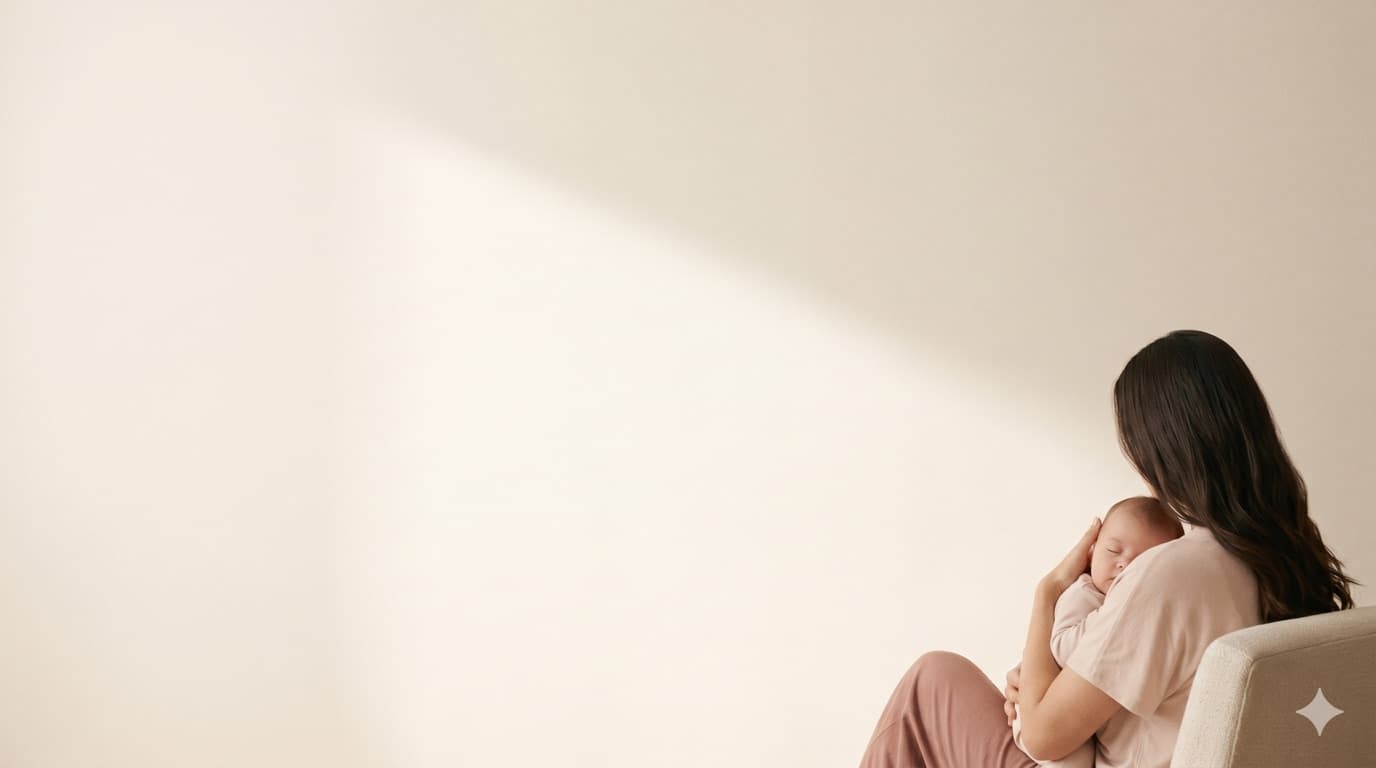
Loneliness in early motherhood is not a personality problem. It is what happens when a job built for a village is assigned to one or two people who moved away from their village. The data says the setup changed. The mothers keep blaming themselves.
The 3 PM feeding is when it usually lands. The baby is finally quiet, the phone is the only other adult in the room, and a mother scrolls past her old life: friends at restaurants, coworkers at happy hour, the version of her that had conversations. She is surrounded by a family she loves and she has never felt more alone. If that is you, the first thing to know is that almost every mother in your feed has felt exactly this, and almost none of them posted it.
The Village Did Not Fall Apart. It Was Dismantled.
Mothers today spend about 2.8 hours a day on direct, hands on childcare. In 1965 that number was under one hour. Mothers are now doing nearly triple the direct parenting their grandmothers did, while also more often working outside the home, and doing it with a fraction of the nearby adults. Grandparents live in other cities. Friends scattered to careers. Neighborhoods emptied of the daytime women who used to be in them, because they are all at work, which was the point, but nobody restaffed the village.
So the arithmetic of new motherhood quietly inverted. The most labor intensive and isolating stage of family life became the one we do with the fewest hands. Mothering without a village is not a niche circumstance. In 2026 it is the default.
Loneliness Is a Health Signal, Not a Mood
The US Surgeon General treated loneliness as a public health crisis back in 2023, comparing its mortality risk to smoking. For new mothers the stakes are sharper: loneliness in the first year is one of the most consistent aggravators of postpartum depression and anxiety, and one of the least screened. Everyone asks about feeding and sleep. Almost nobody asks who you talked to today, which is a shame, because the answer for too many mothers is the baby.
And here is the part nobody says out loud: you can be lonely in a full house. Loneliness is not the absence of people. It is the absence of being known. A partner can be present and still not carrying what you are carrying, which is why the mental load is its own kind of isolation. The person who holds all the remembering is structurally alone inside the family, because what she carries is invisible while she carries it.
Why the Standard Advice Misses
Join a mom group is the stock answer, and it is not wrong, it is just incomplete. New mom loneliness is not only a shortage of acquaintances. It is a shortage of two things: people who genuinely see the load, and relief from the load itself. A mothers group delivers the first, sometimes, after months. Almost nothing in the standard advice addresses the second, which is why mothers can sit in a room full of other mothers and still feel alone at 10 PM when the loop list starts running. The village that raised previous generations did not only provide company. It took shifts.
Rebuilding a Micro Village
The realistic version is small. One person who checks on you, not the baby. One scheduled contact that survives cancellations. One domain of family logistics that stops being yours, permanently, which is a village function even when a tool performs it. The research on building your village is right that circles are built slowly, and wrong if it implies mothers must build them alone, on top of everything else. Ask for the specific thing: come sit with me while I feed her, call me at nine, take the form I keep forgetting. Specific requests build villages faster than open invitations.
Where AlphaMa Comes In
Some of what a village provided was presence at impossible hours, and someone besides you keeping track of what needs tracking. AlphaMa is an AI agent for mothers that covers both: someone to talk to at 3 AM when the feeding is long and the house is quiet, and a carrier for the loops, the appointments and forms and follow ups that otherwise run as a lonely background process in one overworked head. It is not a replacement for human company. It is the piece of the village that never sleeps and never needs you to explain what the mental load is.
Tonight, send one specific ask to one person. And if the nights are the hardest part, you do not have to be the only one awake in your own house anymore.
This article is part of the AlphaMa series on maternal mental health and the mental load.
Sources
- US Surgeon General Advisory, 2023: Epidemic of Loneliness and Isolation, including the mortality risk comparison to smoking and the call to rebuild social connection https://www.hhs.gov/sites/default/files/surgeon-general-social-connection-advisory.pdf
- American Time Use Survey via Business Insider, August 23 2026: mothers of children ages five and under spend about 2.8 hours per day on direct childcare versus under one hour in 1965, while modern families live with fewer nearby adults https://www.businessinsider.com/parents-breaking-point-ai-companies-opportunity-2026-8
- Postpartum support literature consistently identifying loneliness and lack of social support as aggravating factors for postpartum depression and anxiety, per postpartum support organizations and perinatal mental health Alliance guidance https://postpartum.net/perinatal-mental-health/
- University of Bath via ScienceDaily, December 2024. Mothers manage about 71 percent of household cognitive labor, the invisible remembering layer associated with isolation inside the household. Published in the Journal of Marriage and Family https://www.sciencedaily.com/releases/2024/12/241212150327.htm